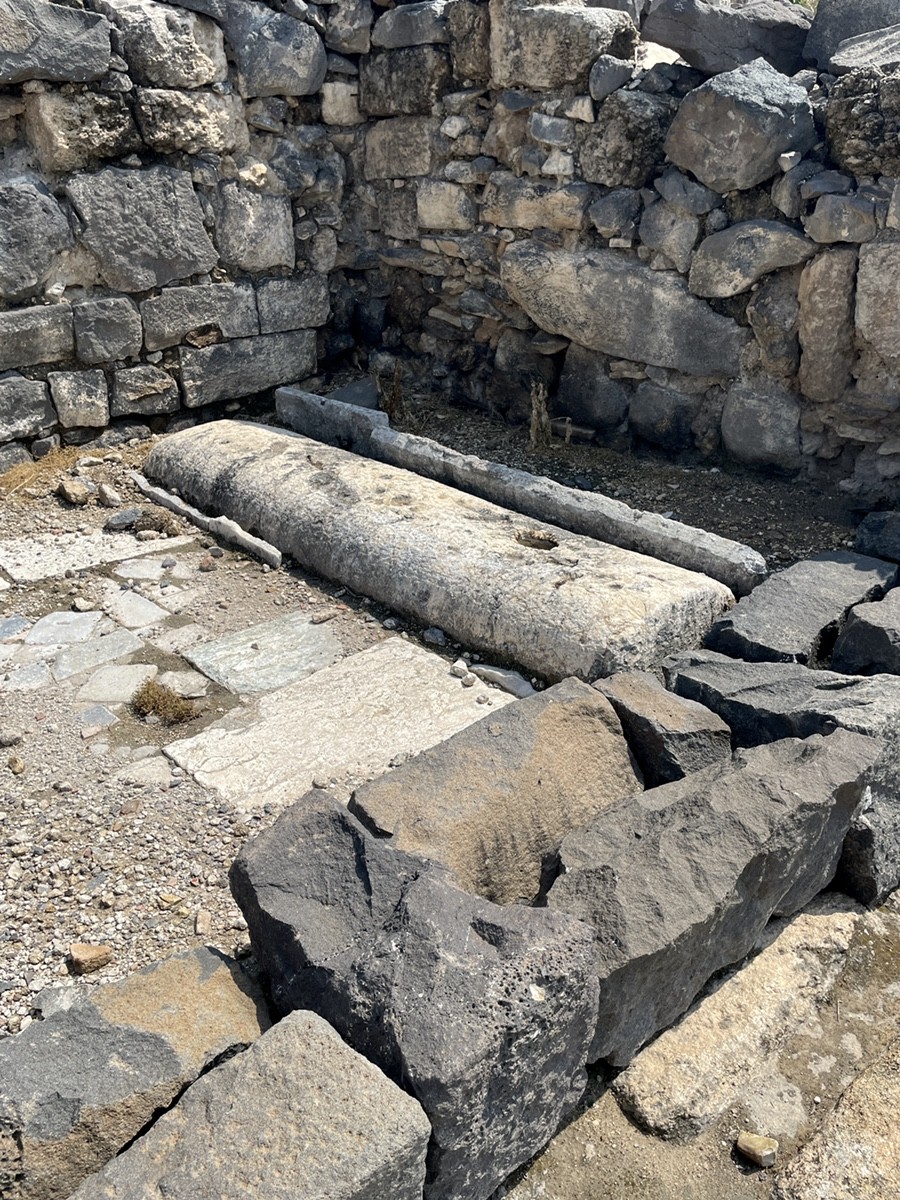

The transition from Roman Hippos to Byzantine Sussita (5th–7th centuries) is the story of a pagan trading hub turning into a powerful religious fortress. It wasn't just a change in religion; it was a total social and architectural makeover.
Byzantine Sussita: The Holy Fortress In this era, Sussita became the seat of a Bishop and a major hub for pilgrims visiting the Sea of Galilee. This new "theocratic" identity changed the city's very face.
- The Power of "Spolia" (Recycling the Past) The Christians didn't just build new churches; they recycled the Roman ruins. This practice is called spolia.
Ideological Flex: They used pagan Roman columns as doorsteps or foundations for churches. It was a way of literally "stepping on" the old gods.
Imperial Quality: You'll see high-quality grey granite and Proconnesian marble in the churches, mostly "borrowed" from older Roman temples to show off the city's status as an Episcopal centre.
A City of Eight Churches Even though the mountain is small, it is packed with at least eight churches. Money that used to go to theatres and stadiums was now poured into intricate mosaics and religious basilicas.
Survival Under Islam When the Muslims conquered the area in 635 AD, the city didn't fall. In fact, it thrived for another 100 years.
Continuity: The Christian community paid a tax (jizya) but kept their Bishop and their churches. Archaeologists found that churches were being repaired right up until the mid-8th century.
The Sudden End: The city didn't fade away slowly. The massive earthquake of 749 AD froze the city in its prime. When the ground shook, the columns fell, and the Byzantine era was perfectly "preserved" under the rubble.
Imagine the perfect spring morning in Israel—the sun is warm but not yet "blasting" you, and the air smells like fresh wildflowers. It's the absolute best time to grab the keys and head to the eastern side of the Kinneret (Sea of Galilee).
First Stop: Kursi & The Views Start your day at Kursi. It's this massive Byzantine monastery ruin where the vibe is just... super chill. You can walk across ancient mosaics and literally feel the history. But don't stay too long because the drive up the mountain is even better. Make sure to pull over at Mitzpe Nukieb. On a clear day, the view is insane—you see the whole blue "bowl" of the Kinneret stretched out from Tiberias to the Golan Heights. It's one of those "stop and just stare" moments.
The Main Event: Susita (Hippos) Then, you've got the crown jewel: Susita. It's like a ghost city sitting on a hill. They call it the "Pompeii above the lake." You'll walk through the old Roman forum and see giant columns that were knocked down by an earthquake 1,200 years ago and just... stayed there. It's got this wild mix of ancient Roman vibes and old Israeli military outposts.
Trains and Hummus When you head back down, swing by the old Tzemach train station. It's been restored and feels like a movie set from the early 1900s—back when trains ran all the way from Haifa to Damascus.
Finally, once you're officially "toured out," hit up Hummus Eliyahu at the Tzemach junction. Trust me, a warm bowl of creamy hummus with olive oil, fluffy pita, and a solid cup of coffee is the only way to end a trip like this.
Pro tip: Go right now while it's spring. The Golan is bright green, and everything looks like a masterpiece.