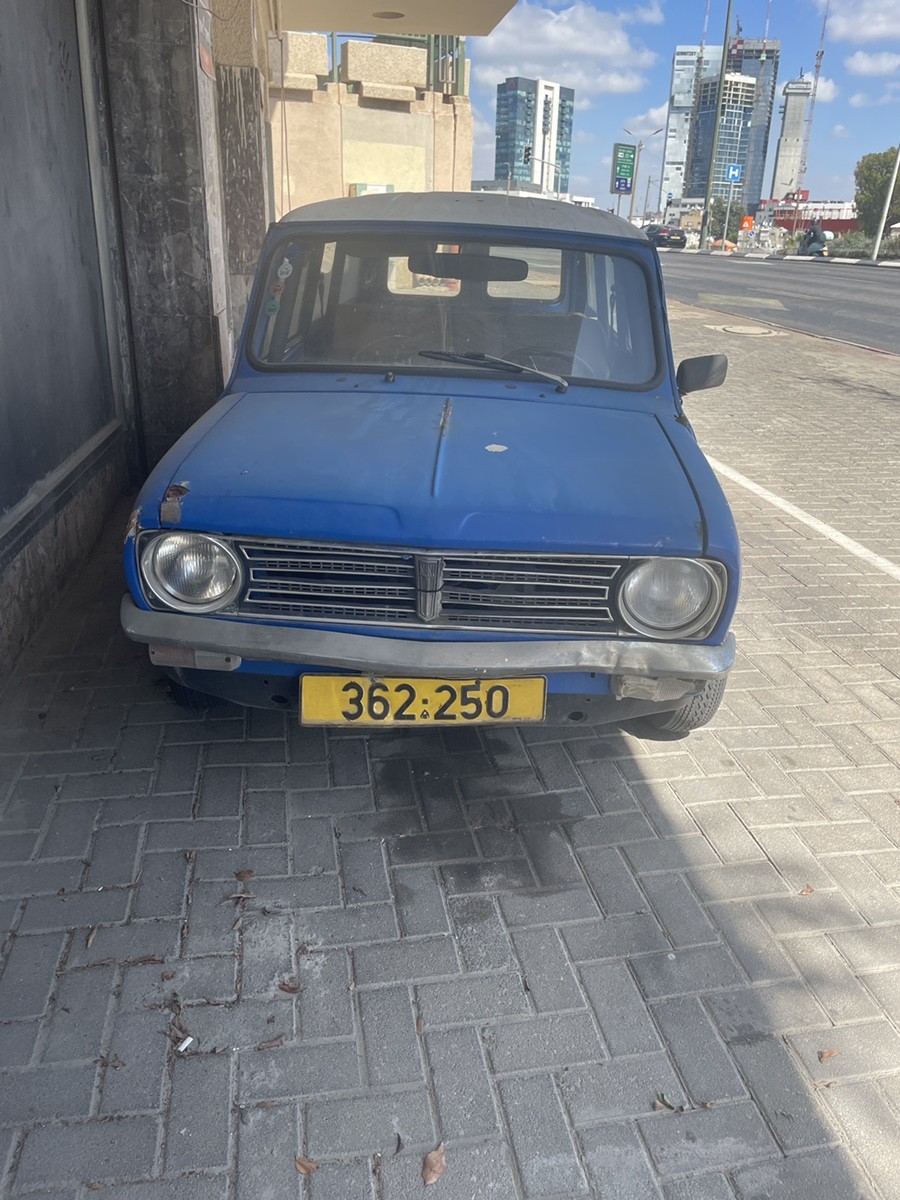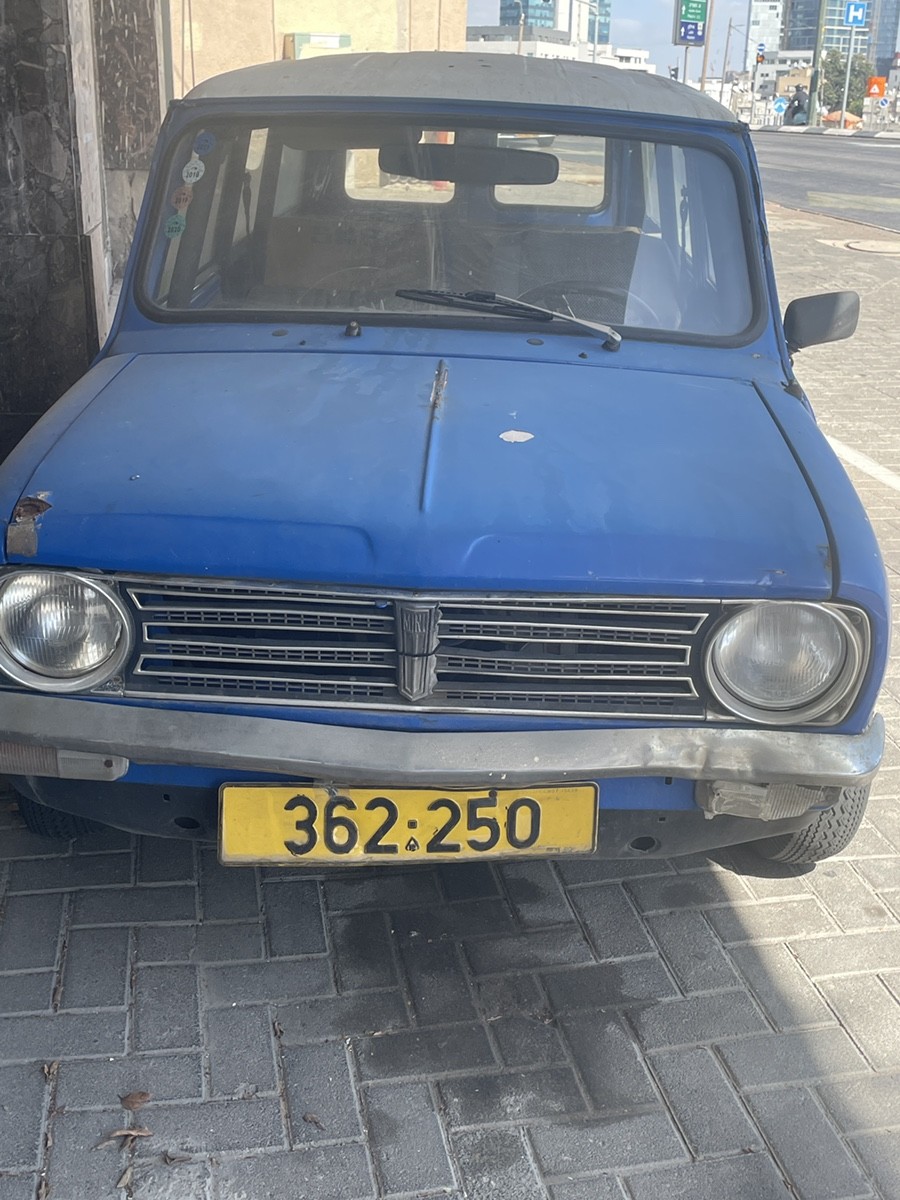

We leave Menachem Begin Boulevard — once the road from Jaffa to Petah Tikva — and turn onto Barzilai Street. In the early 20th century, this was the main entrance to the Hashmal quarter from the “Petah Tikva road.” The street was named after Dr Barzilai, one of the first physicians and public figures of the Yishuv. Look around: here, the layers of old and new blend in the most unexpected way. Beside the wall stands a frozen relic — a **Fiat 127**, the compact Italian car produced from 1971 and introduced to Israel in the mid-’70s. It was the dream car of the middle class — teachers, engineers, small business owners — affordable, efficient, and with a touch of European flair. For many Israelis, it was their first family car and a quiet badge of success.
It also evokes the country’s own brief automotive chapter. In the 1950s and ’60s, Israel tried to build its own cars: in Haifa, the **Kaiser-Frazer Israel** factory first assembled American models. It later produced the legendary **Susita**, a small fibreglass car that became a national icon. Government offices bought fleets of them, and for a while, the Susita ruled Israeli roads. But soon, imported cars like Fiat, Renault, and Simca replaced it, symbolising the shift from local ambition to global modernity.
So, standing here on Barzilai Street beside this pale-blue Fiat, you’re not just looking at an old car. You’re seeing a fragment of history — where the road to Petah Tikva once began, where the Hashmal quarter took shape, and where the dreams of orchards, electricity, and an Israeli automobile industry all met on the same strip of asphalt.
You’ll walk through the very heart of old Tel Aviv — a neighbourhood where orange groves, missionary dreams, and the glow of early electricity all intertwined. The journey begins at the Model Farm and its iconic water tower, the birthplace of irrigation in Eretz Israel. From there, we’ll trace the footsteps of the Ishma’ilov family — Mashhadi *anusim* who built rental houses and inns for Persian merchants, yet lost much of their fortune under dramatic circumstances. We’ll pause in Gan HaHashmal, the city’s second public garden, which has witnessed the romance of the 1920s, decline, and the wave of 21st-century gentrification. The walk culminates at the grand Ohel Moed Synagogue — the “Tent of Meeting” — where eastern communities claimed their rightful place in the growing city. This is a journey through layers of time: from water to electricity, from merchant houses to gardens and synagogues — a story where every street guards a secret and every building speaks for its generation.