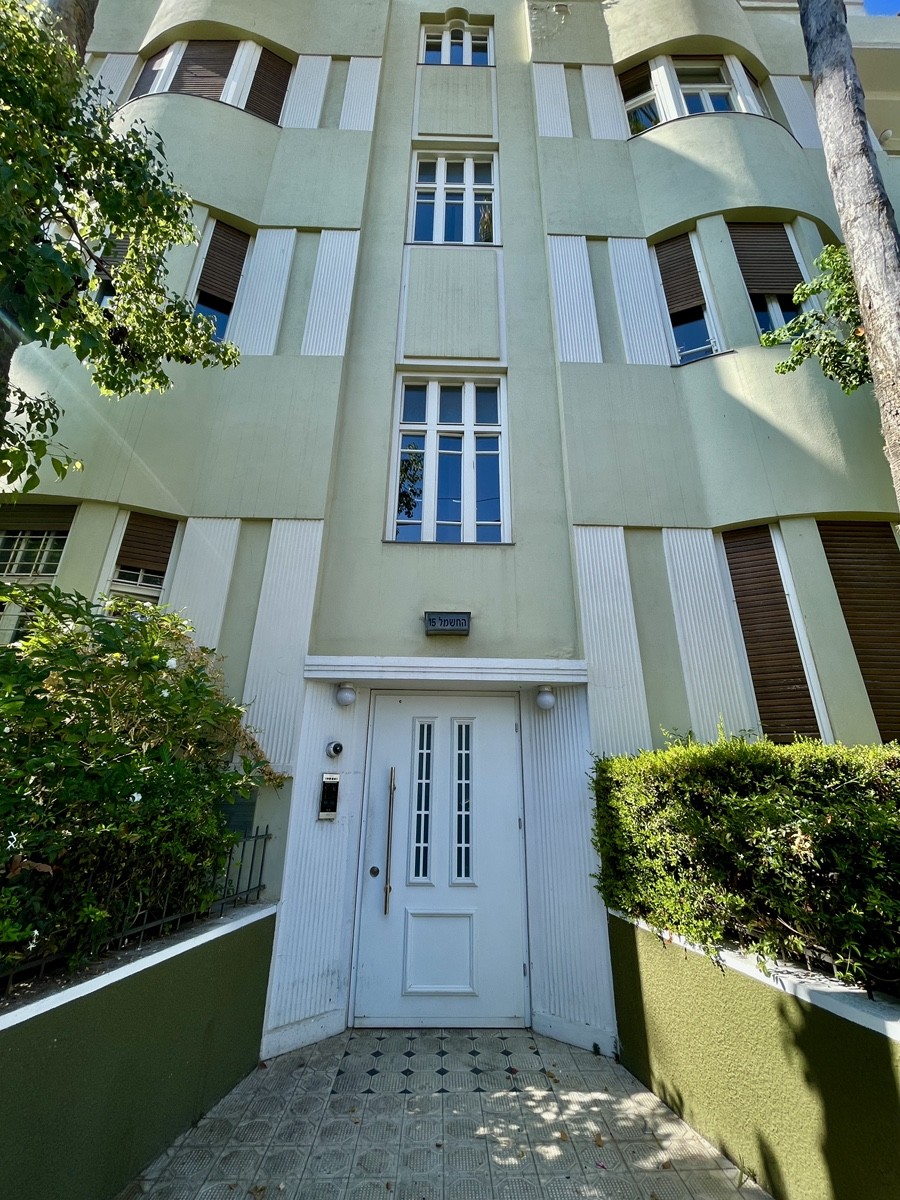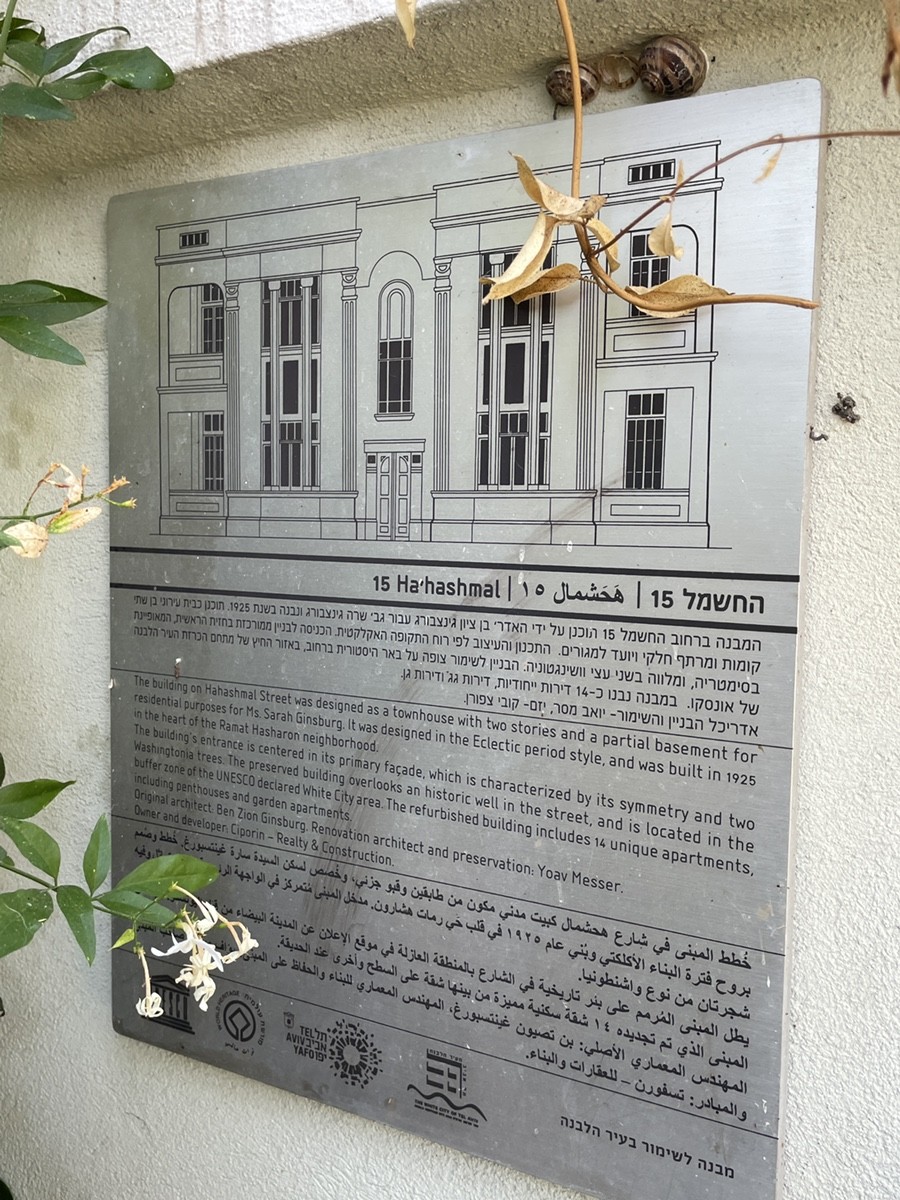

House No. 15 on HaHashmal Street stands directly opposite the old water tower — the same one that once belonged to the Model Farm and became a prototype for the future of Jewish agriculture. The tower, built at the end of the 19th century, later inspired the famous water tower in Rishon LeZion — the birthplace of this house’s architect, **Ben-Zion Ginsburg**. Fate seemed to draw a perfect symmetry: the architect built his home facing the tower, continuing its story — but now in the language of urban architecture.
Ginsburg was a man of his age — elegant, secular, and flamboyant. He dressed with European precision, his suits perfectly tailored, and he had a fascination with cars, still a rarity in the 1920s. Trained at the **Zurich Polytechnic**, he absorbed the spirit of European modernism and refined rationalism. He lived and worked across Europe and spent several years in **Cyprus**, designing hotels and public buildings. There, his style matured — a blend of engineering precision and understated ornamentation.
The house, built in **1925** for his wife **Sarah**, became a bridge between Europe and the emerging Tel Aviv. Its symmetrical façade, tall arched windows, rhythmic columns, and well-balanced proportions embodied the eclectic spirit of the time — disciplined yet romantic. It seemed to declare: “Here begins a new life, on a land where even the stone remembers the farm, the water, and the labour.”
By the 1950s, after years abroad, Ginsburg returned to Israel — to the city that now bore his early works. The tower across the street had already become a monument, and his own home, a quiet part of HaHashmal Street’s living history.
You’ll walk through the very heart of old Tel Aviv — a neighbourhood where orange groves, missionary dreams, and the glow of early electricity all intertwined. The journey begins at the Model Farm and its iconic water tower, the birthplace of irrigation in Eretz Israel. From there, we’ll trace the footsteps of the Ishma’ilov family — Mashhadi *anusim* who built rental houses and inns for Persian merchants, yet lost much of their fortune under dramatic circumstances. We’ll pause in Gan HaHashmal, the city’s second public garden, which has witnessed the romance of the 1920s, decline, and the wave of 21st-century gentrification. The walk culminates at the grand Ohel Moed Synagogue — the “Tent of Meeting” — where eastern communities claimed their rightful place in the growing city. This is a journey through layers of time: from water to electricity, from merchant houses to gardens and synagogues — a story where every street guards a secret and every building speaks for its generation.