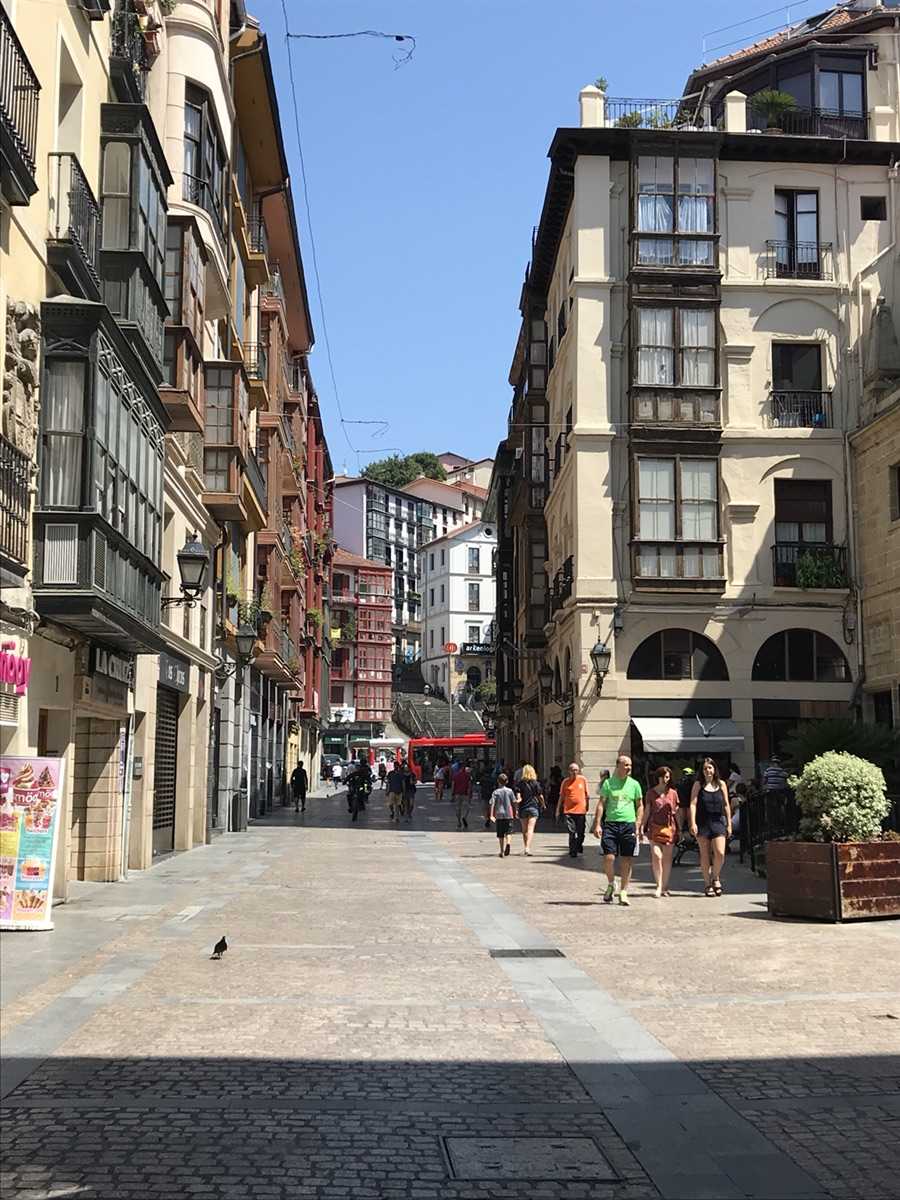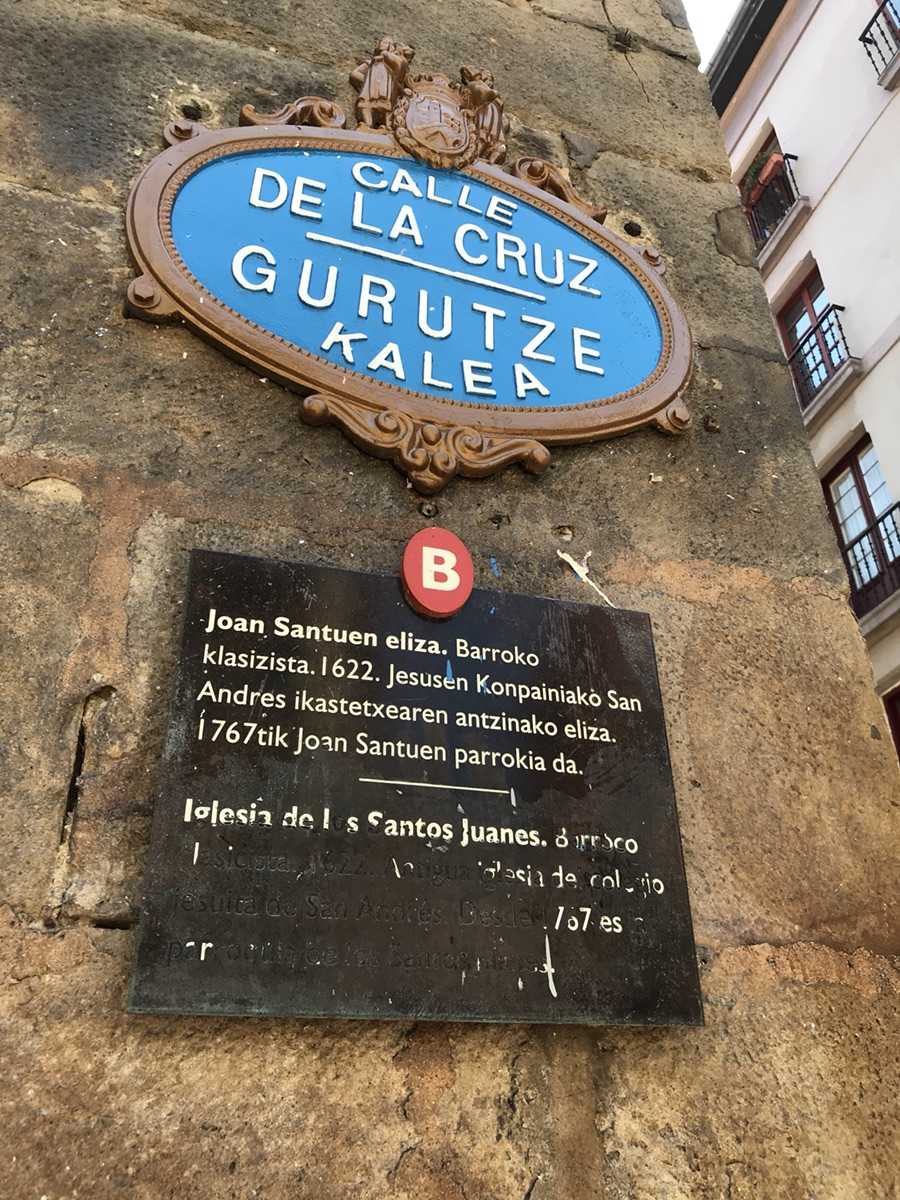

Walking through old Bilbao and turning onto Calle de la Cruz, you feel the city’s early heartbeat. This was one of the original seven streets — the narrow beginnings from which Bilbao grew. A stone cross once stood here, giving the street its name. For travelers it was a sign of protection; for the townspeople, a marker of faith and guardianship. The plaques on the walls still tell that story: how in the thirteenth century the city rose from seven cramped lanes, how wooden houses burned again and again, and how in the nineteenth century Bilbao rebuilt itself into the place we see today, with its squares like Plaza Nueva and San Francisco.
On this street stands the Church of San Juanes, one of the oldest in the city, built in 1622. Its strict, almost stern façade — a blend of classical lines and Baroque gravity — matches the Basque character well: no excess, just stone, time, and dignity. The church once belonged to the Jesuits, the order founded by Saint Ignatius of Loyola — the Basque whose name became a symbol of scholarship and spiritual resolve.
Everything changed in 1767, when King Charles III, a monarch shaped by Enlightenment ideas, expelled the Jesuits from Spain. They were respected, but also feared — too educated, too independent, too capable of shaping minds and politics. Their property was seized, their schools and churches handed over to the city. San Juanes lost its Jesuit identity and became the parish church of the Two Johns.
That story mirrors the evolution of Bilbao itself. A town born of faith and craftsmanship gradually became a city of commerce, industry, banks, and theaters. Places once dedicated to theology now teach economics and art. And standing before the walls of this church, you realize: Bilbao knows how to change, but it never forgets those who helped it grow.
This walk is not just a stroll through the old streets of Bilbao — it’s a walk through the city’s memory. Everything here lies close together: the Gothic gates of Santiago Cathedral, the soft murmur of the “Dog Fountain,” the old plaques still marked by the great flood of 1983, and Bar Xukela, where the spirit of the city lives in a glass of wine and laughter at the counter.
We follow Calle del Perro and Calle de la Torre — streets whose names hold legends and the echoes of ancient family towers. At every turn, a story appears: about the Basques, whose defensive towers once stood like the stone houses of Svaneti; about Diego María Gardoki, the first Basque to serve as Spain’s ambassador to the United States; about Pedro Arrupe, the Basque priest who renewed the Jesuit order in the twentieth century.
Our path leads to the river where ships once lined the shore, and finally to El Arenal — the park where Bilbao learned to breathe, to love, and to listen to the quiet rhythm of its own heart.
This walk is like a simple, honest conversation with the city — no guide, no performance, just a friend who has a story waiting behind every corner.