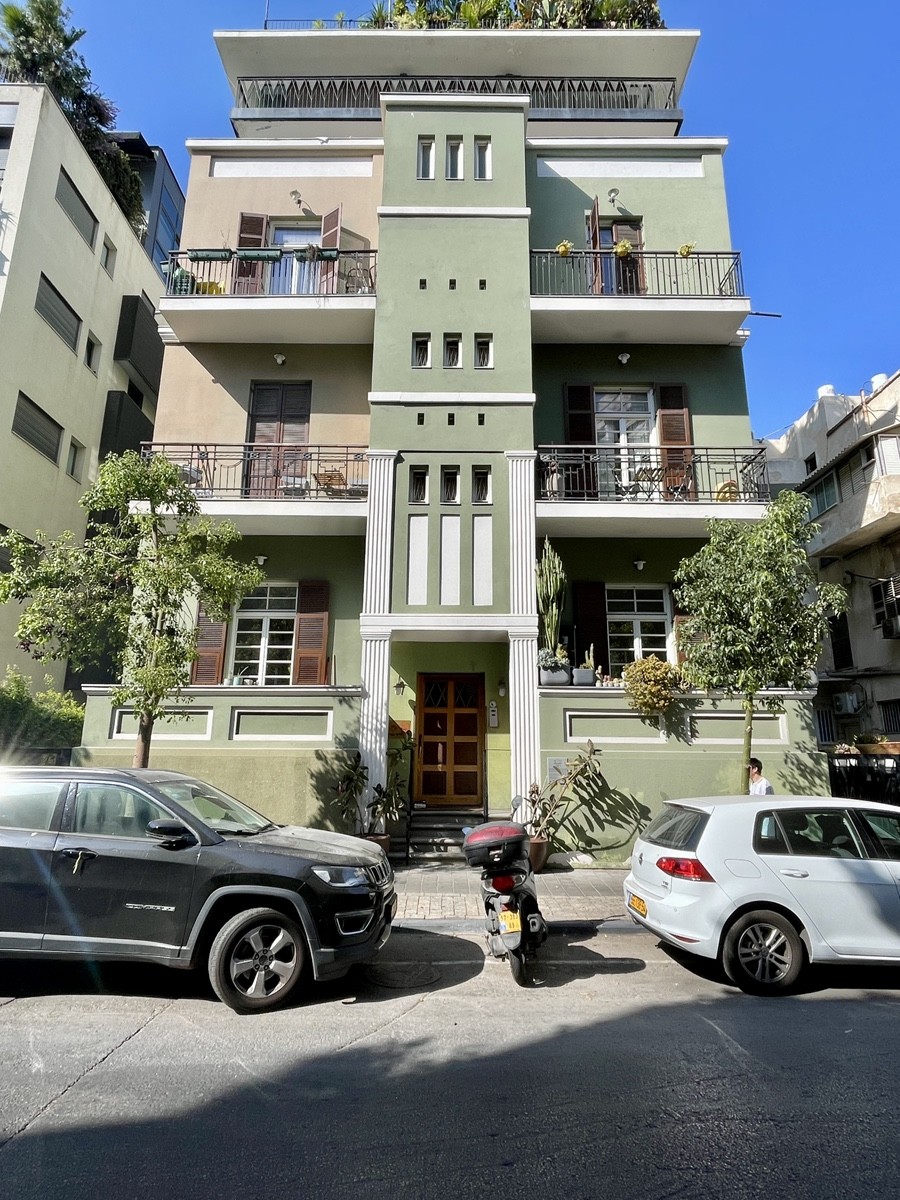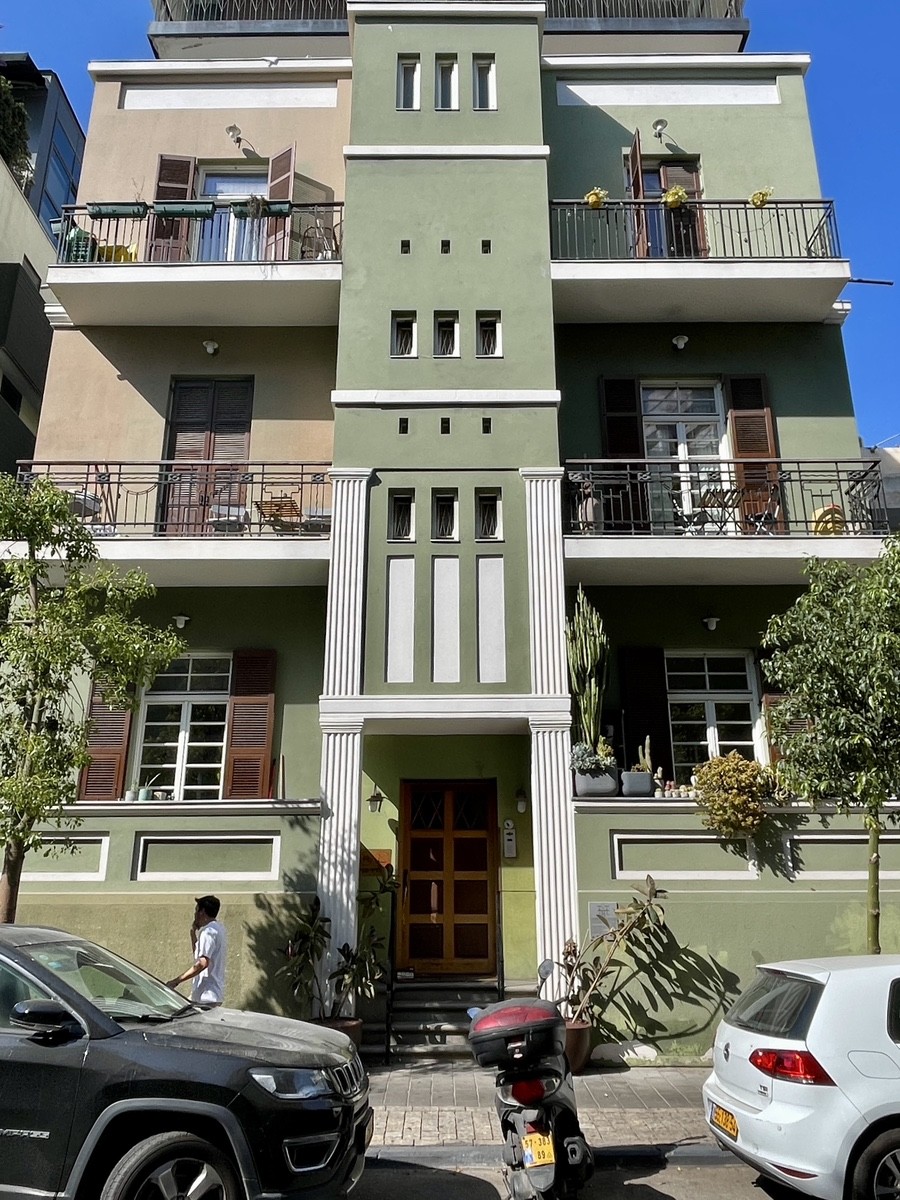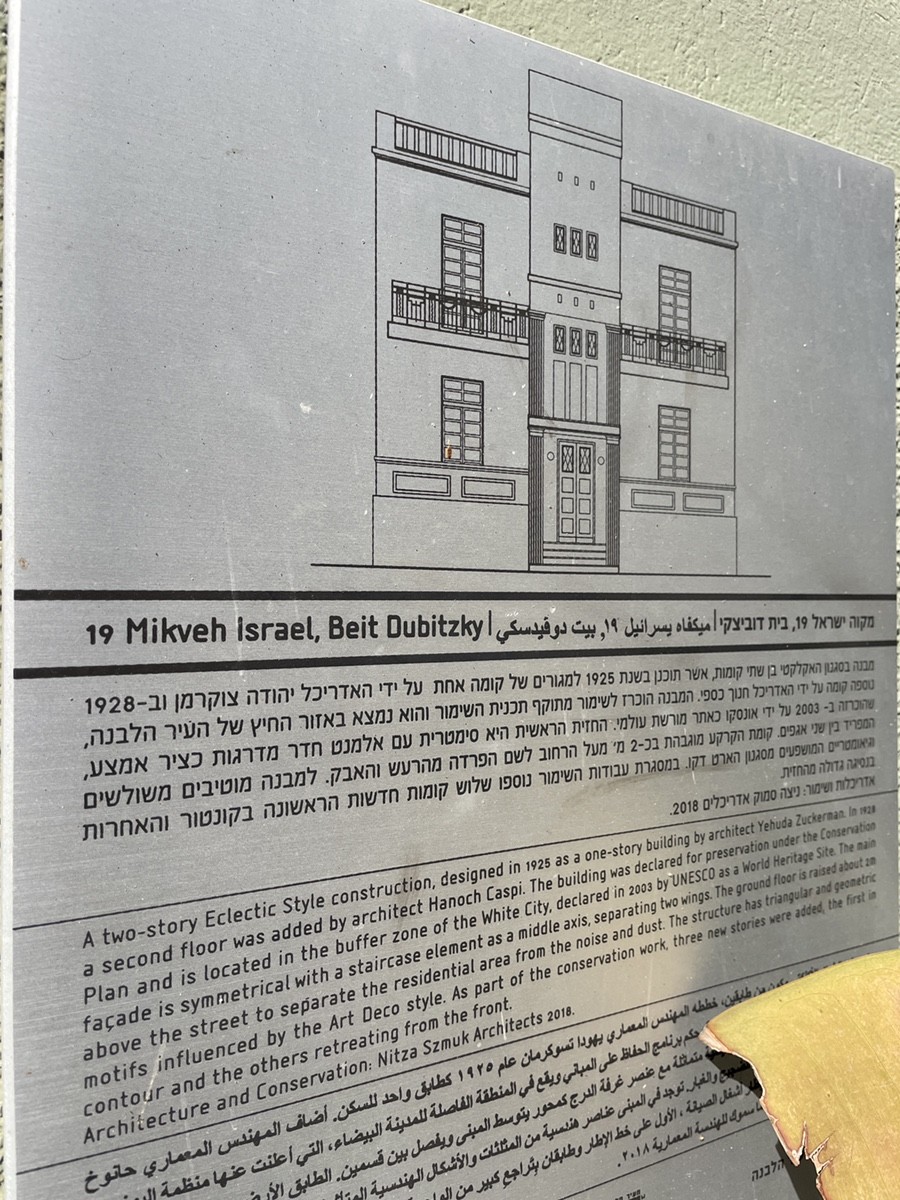

The Dubitsky House at 19 Mikveh Israel Street is more than just a building — it’s a small human drama inscribed in the symmetry of its façade and in the fate of a city learning to stand on its own. It was built in 1925 by **Yitzhak and Hana Dubitsky**, a couple who seemed to have everything aligned: a bit of capital, some ambition, and a deep desire to belong to the new world. They commissioned **Yehuda Zuckerman**, an architect of the German school who blended European rigour with Mediterranean warmth. His style was distinctive — clean lines, balanced symmetry, a central stairwell volume, and a touch of Art Deco grace.
Zuckerman wasn’t an avant-gardist, but neither was he nostalgic. His buildings bridged tradition and what would later become known as the *White City*. The Dubitsky House turned out almost perfect: a harmonious façade, elegant balconies, precise proportions. Inside — high ceilings, cool rooms, and a staircase leading to the roof, where at night one could see the lights of Jaffa. Hana hosted tea gatherings, neighbours dropped by with their children, and Yitzhak dreamed of a future where, behind every street number, stood the word “city.”
Then came **1931**. The economic crisis hit hard — debts, repossessions, furniture sold through public auction. *Haaretz* reported dryly: “Sold — an armchair, a sofa, a clock, a desk.” A house built on hope had become a reminder of how quickly stability can collapse. By **1936**, the family had moved to **Hissin Street**, and new owners — **Daniel Sporta** and **Yaakov Birisi** — added a floor, commissioning **architect Hanoch Caspi**. Sporta was practical; Birisi, a Sicilian entrepreneur, saw not memory but investment. They kept Zuckerman’s façade but changed its soul — the house stopped being a story and became real estate.
It’s said that the Dubitsky sons, **Michael and Gabriel**, never returned. One moved to Haifa, the other abroad. Their fates dissolved into time, like the house itself, nearly swallowed by new construction — until **architect Nitsa Smok** restored it in **2018**. The façade was cleaned, the balconies straightened, the stairwell reopened to light — and the old house began to breathe again.
You’ll walk through the very heart of old Tel Aviv — a neighbourhood where orange groves, missionary dreams, and the glow of early electricity all intertwined. The journey begins at the Model Farm and its iconic water tower, the birthplace of irrigation in Eretz Israel. From there, we’ll trace the footsteps of the Ishma’ilov family — Mashhadi *anusim* who built rental houses and inns for Persian merchants, yet lost much of their fortune under dramatic circumstances. We’ll pause in Gan HaHashmal, the city’s second public garden, which has witnessed the romance of the 1920s, decline, and the wave of 21st-century gentrification. The walk culminates at the grand Ohel Moed Synagogue — the “Tent of Meeting” — where eastern communities claimed their rightful place in the growing city. This is a journey through layers of time: from water to electricity, from merchant houses to gardens and synagogues — a story where every street guards a secret and every building speaks for its generation.