
El Arenal was once a sandy stretch of land shaped by the curve of the estuary. In the Middle Ages, this area served as Bilbao’s shipyard zone — boats were built and launched from these banks. But starting in the 16th century the land slowly dried out, the shipyards disappeared, and the space turned into avenues and groves. El Arenal became a park — “the most delightful spot in town,” a place where people gathered at all hours.
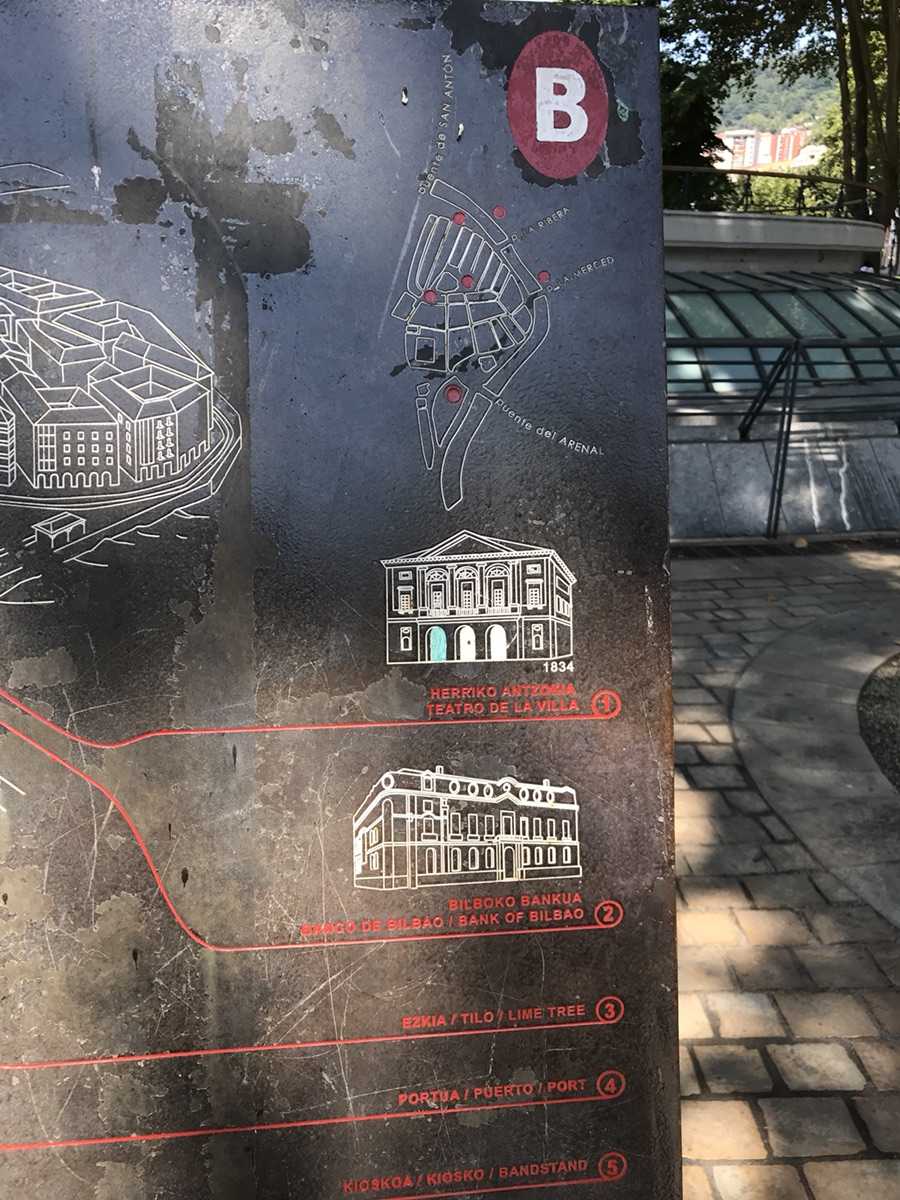
For generations it was Bilbao’s favorite promenade. Gentlemen walked beside shopkeepers and office clerks; priests strolled carefully behind nannies; soldiers flirted with them under the shade of the trees. In 1817, the first theater of Bilbao was built here. It was replaced in 1834 by the Teatro de la Villa, designed by Juan Bautista de Escondrillas, which later suffered damage during the 1874 bombings. Between 1886 and 1890 the current theater was constructed — the one designed by Joaquín Rucoba, now known as the Arriaga Theatre, in honor of Bilbao’s most celebrated composer.
On the site of the former San Nicolás Inn — once the most important inn in the town — the headquarters of the Bank of Bilbao was built between 1862 and 1866. Designed by Eugène Lavallé, it became the financial symbol of the rising merchant class.
The famous Arenal lime tree was planted in 1816 and became a beloved landmark until a storm brought it down in 1948. And although El Arenal functioned as a public park, the waterfront beside it continued to operate as part of the port well into the 20th century.
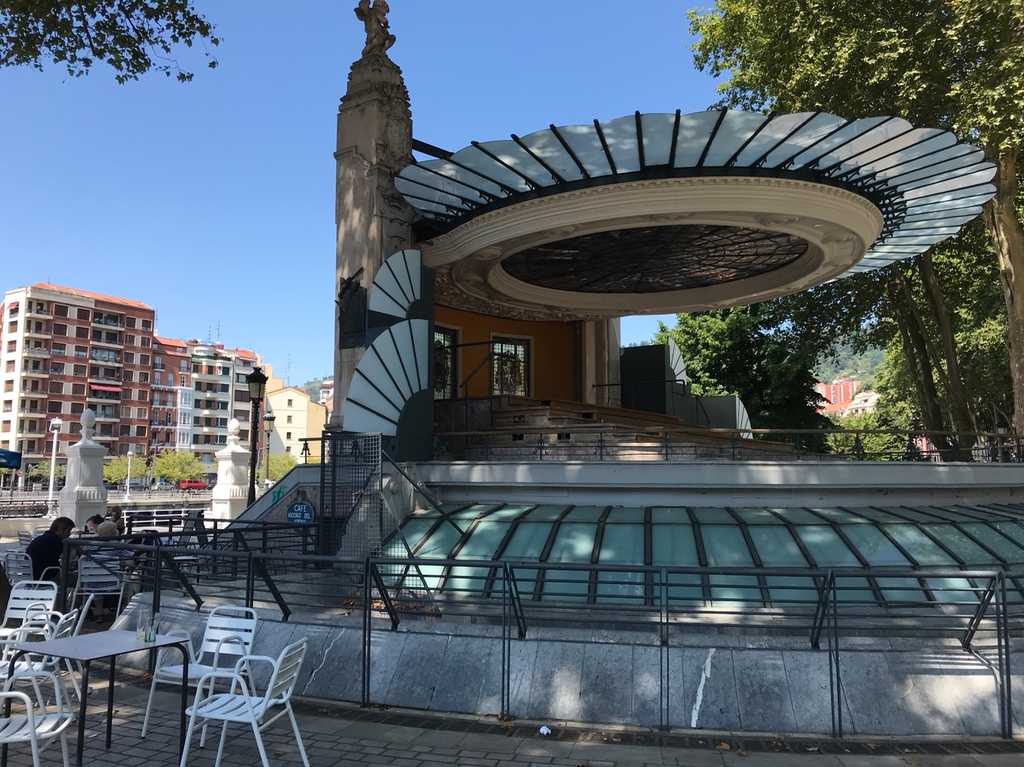
The Arenal bandstand, altered over time but faithful to its purpose, still hosts concerts by the Bilbao Municipal Band and the traditional txistularis — Basque flute players accompanied by drums.
For many locals, the nearby Church of San Nicolás is simply the backdrop to their walks. Yet inside it holds remarkable Baroque altarpieces and sculptures by Juan Pascual de Mena — one of the finest examples of full Bizkaian Baroque.
A short walk away stands the Gómez de la Torre Mansion (1789–1791), one of the first neoclassical civil buildings in Bizkaia — austere, functional, and elegant in its simplicity.
In the 19th century, Calle Viuda de Epalza became the final expansion of the Old Quarter. It was lined with grand homes belonging to Bilbao’s wealthiest families, including that of Casilda Iturrizar, widow of banker Tomás José Epalza, whose name the street still carries.
This walk is not just a stroll through the old streets of Bilbao — it’s a walk through the city’s memory. Everything here lies close together: the Gothic gates of Santiago Cathedral, the soft murmur of the “Dog Fountain,” the old plaques still marked by the great flood of 1983, and Bar Xukela, where the spirit of the city lives in a glass of wine and laughter at the counter.
We follow Calle del Perro and Calle de la Torre — streets whose names hold legends and the echoes of ancient family towers. At every turn, a story appears: about the Basques, whose defensive towers once stood like the stone houses of Svaneti; about Diego María Gardoki, the first Basque to serve as Spain’s ambassador to the United States; about Pedro Arrupe, the Basque priest who renewed the Jesuit order in the twentieth century.
Our path leads to the river where ships once lined the shore, and finally to El Arenal — the park where Bilbao learned to breathe, to love, and to listen to the quiet rhythm of its own heart.
This walk is like a simple, honest conversation with the city — no guide, no performance, just a friend who has a story waiting behind every corner.