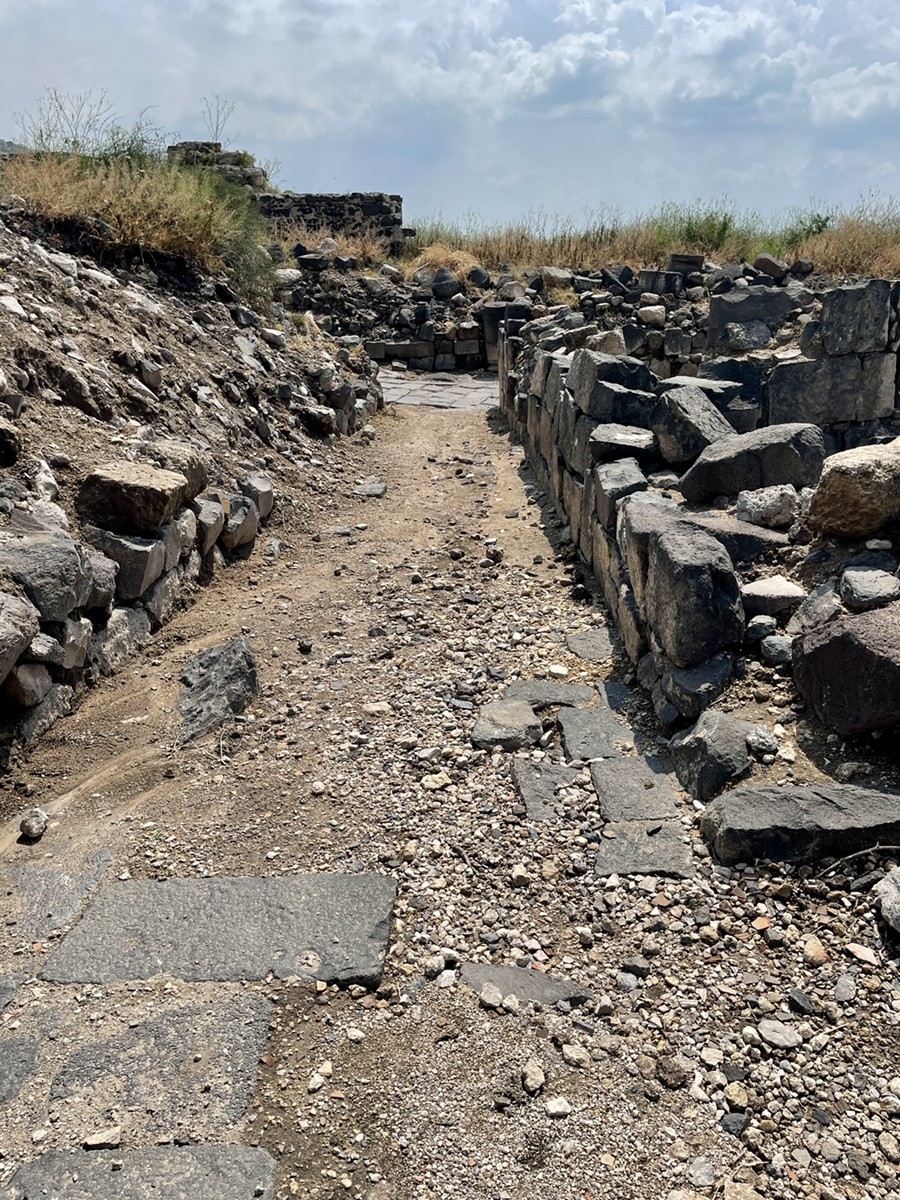

While the temples and baths represent the "glamour" of the city, the residential quarters are where you find the real soul of Susita. This is where the local basalt stops being a building material and starts being a way of life.
Life in the "Black City" In the residential areas, you leave the wide, marble-lined avenues behind and enter a maze of narrow alleys and courtyards. This was the "Black City"—built almost entirely from the tough, dark basalt of the Golan.
- The Insulae (Apartment Blocks) People lived in tight-knit blocks called insulae, separated by skinny passages.
The Courtyard Life: Most houses are centred around a courtyard paved with basalt slabs. This was the multi-tasking hub of the home where families cooked, did laundry, and stored their grain.
Vertical Living: The ground floors were built with thick basalt to support a second story, which was often made of wood.
- The Sound of Grinding Stone Susita wasn't just a fortress; it was a massive agricultural factory.
Basalt Tools: Because basalt is hard and slightly porous, it was the "gold standard" for grinding.
Donkey Mills: In these courtyards, you'll see massive basalt millstones (meta and catillus). These were powered by donkeys or people, grinding the grain that fed the city. You might also spot heavy stone basins used for pressing olives into oil.
- The 749 AD "Collapse" The residential quarters show the brutal reality of the 749 AD earthquake.
The Falling Giants: When the ground shook, the massive granite and marble columns from the fancy public buildings nearby didn't just fall—they crushed the houses next to them.
A Frozen Moment: You can see giant columns lying right on top of humble basalt floors. Because the city was never really rebuilt, it stayed exactly like that—a snapshot of a bustlingneighbourhoodd trapped forever under its own ruins.
Imagine the perfect spring morning in Israel—the sun is warm but not yet "blasting" you, and the air smells like fresh wildflowers. It's the absolute best time to grab the keys and head to the eastern side of the Kinneret (Sea of Galilee).
First Stop: Kursi & The Views Start your day at Kursi. It's this massive Byzantine monastery ruin where the vibe is just... super chill. You can walk across ancient mosaics and literally feel the history. But don't stay too long because the drive up the mountain is even better. Make sure to pull over at Mitzpe Nukieb. On a clear day, the view is insane—you see the whole blue "bowl" of the Kinneret stretched out from Tiberias to the Golan Heights. It's one of those "stop and just stare" moments.
The Main Event: Susita (Hippos) Then, you've got the crown jewel: Susita. It's like a ghost city sitting on a hill. They call it the "Pompeii above the lake." You'll walk through the old Roman forum and see giant columns that were knocked down by an earthquake 1,200 years ago and just... stayed there. It's got this wild mix of ancient Roman vibes and old Israeli military outposts.
Trains and Hummus When you head back down, swing by the old Tzemach train station. It's been restored and feels like a movie set from the early 1900s—back when trains ran all the way from Haifa to Damascus.
Finally, once you're officially "toured out," hit up Hummus Eliyahu at the Tzemach junction. Trust me, a warm bowl of creamy hummus with olive oil, fluffy pita, and a solid cup of coffee is the only way to end a trip like this.
Pro tip: Go right now while it's spring. The Golan is bright green, and everything looks like a masterpiece.