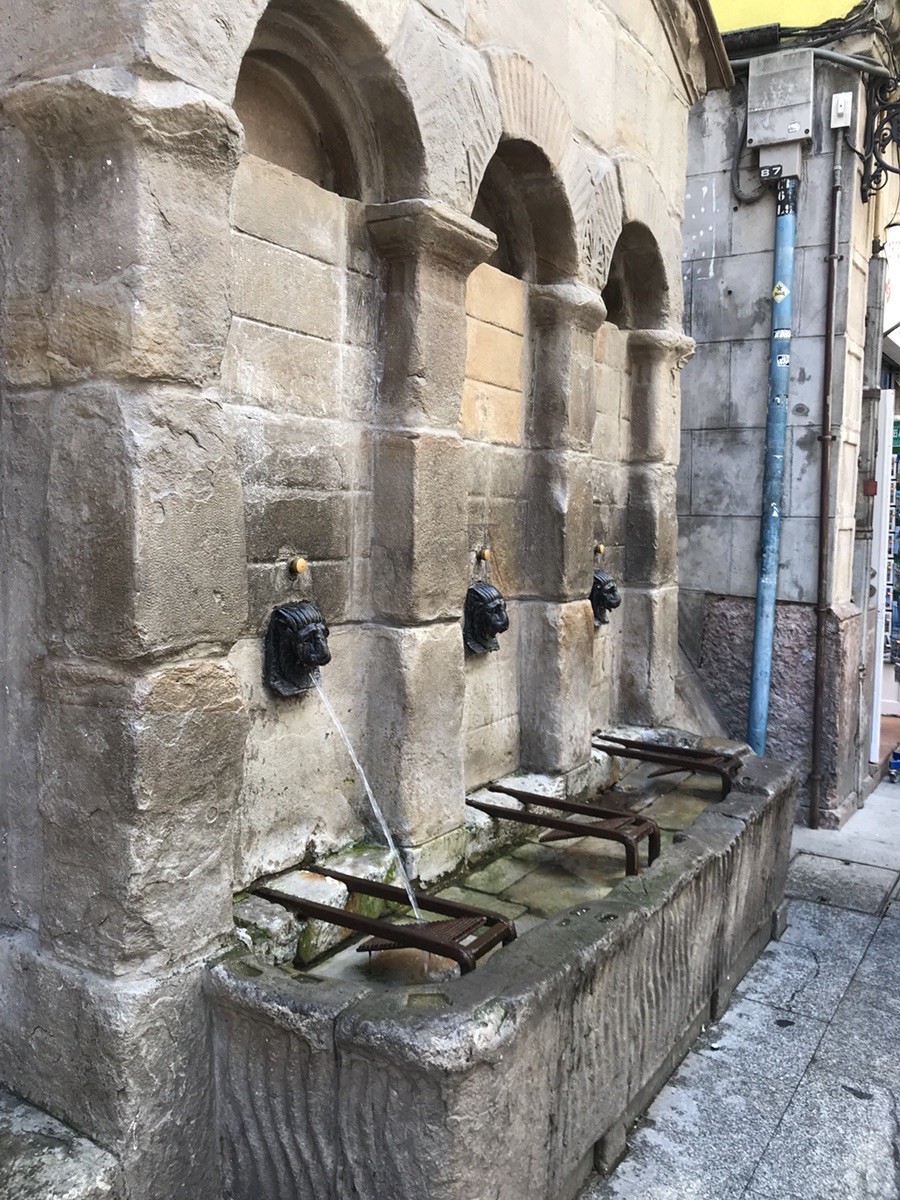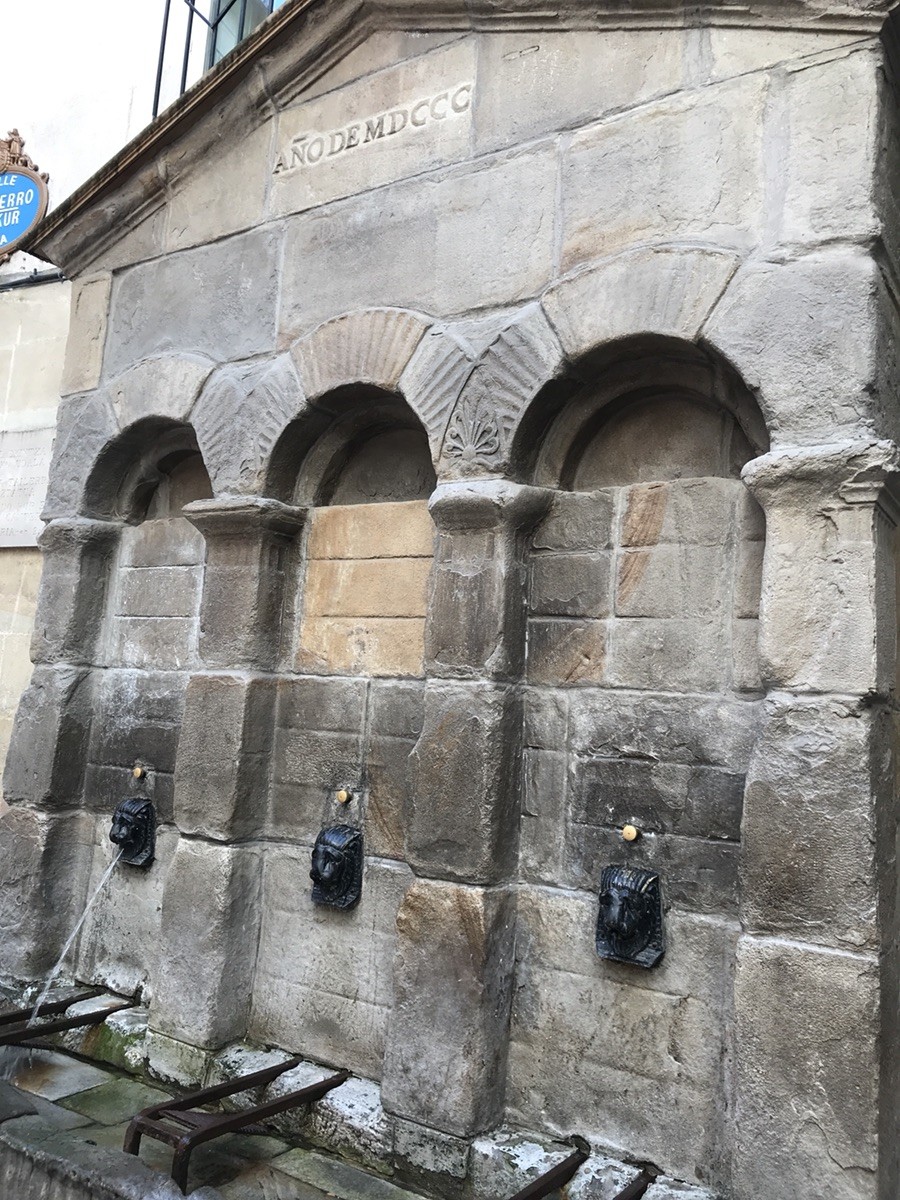

If you turn off Calle Tendería and wander a little deeper into old Bilbao, you eventually come across a small fountain that is both charming and slightly comical — the Fuente del Perro, the “Dog Fountain.” The funny part is that there isn’t a single dog on it. Water pours from the mouths of three stone lions, and locals joke that the name stuck simply because “no dog has ever drunk from it.”
The fountain dates back to 1800, a moment when Bilbao was beginning to step out of its medieval tightness and into a more modern era. Its style is pure Neoclassicism — clean lines, balanced proportions, a clear nod to ancient architecture. The upper section looks like a tiny temple; the lower, like a sarcophagus, as if hinting at the quiet cycle of life and rest.
In its time, the fountain wasn’t just decoration. Before Bilbao had a central water system, people came here with pitchers, filling them for the day. In the evenings neighbors gathered around it — to share news, trade gossip, or simply cool off after a hot afternoon. It was a meeting point long before cafés and social networks existed.
Today the Fuente del Perro is one of those places where you can feel old Bilbao almost physically. It carries the city’s spirit — a mix of dry humor, pride, and unhurried life. If you stop beside the lion heads and listen to the water, it’s easy to imagine the same voices, the same laughter, the same slow rhythm that filled this spot two centuries ago. This is the heartbeat that still makes Casco Viejo so unmistakably alive.
This walk is not just a stroll through the old streets of Bilbao — it’s a walk through the city’s memory. Everything here lies close together: the Gothic gates of Santiago Cathedral, the soft murmur of the “Dog Fountain,” the old plaques still marked by the great flood of 1983, and Bar Xukela, where the spirit of the city lives in a glass of wine and laughter at the counter.
We follow Calle del Perro and Calle de la Torre — streets whose names hold legends and the echoes of ancient family towers. At every turn, a story appears: about the Basques, whose defensive towers once stood like the stone houses of Svaneti; about Diego María Gardoki, the first Basque to serve as Spain’s ambassador to the United States; about Pedro Arrupe, the Basque priest who renewed the Jesuit order in the twentieth century.
Our path leads to the river where ships once lined the shore, and finally to El Arenal — the park where Bilbao learned to breathe, to love, and to listen to the quiet rhythm of its own heart.
This walk is like a simple, honest conversation with the city — no guide, no performance, just a friend who has a story waiting behind every corner.