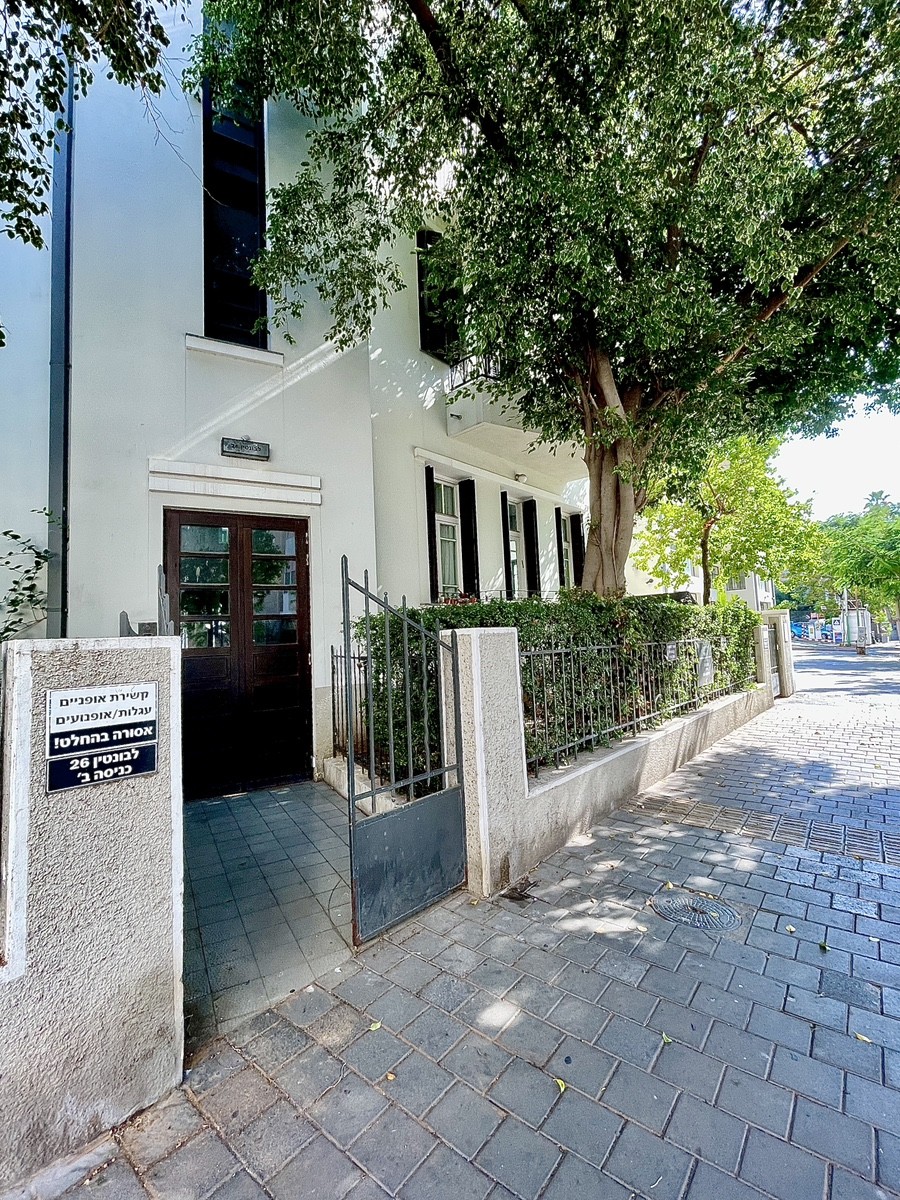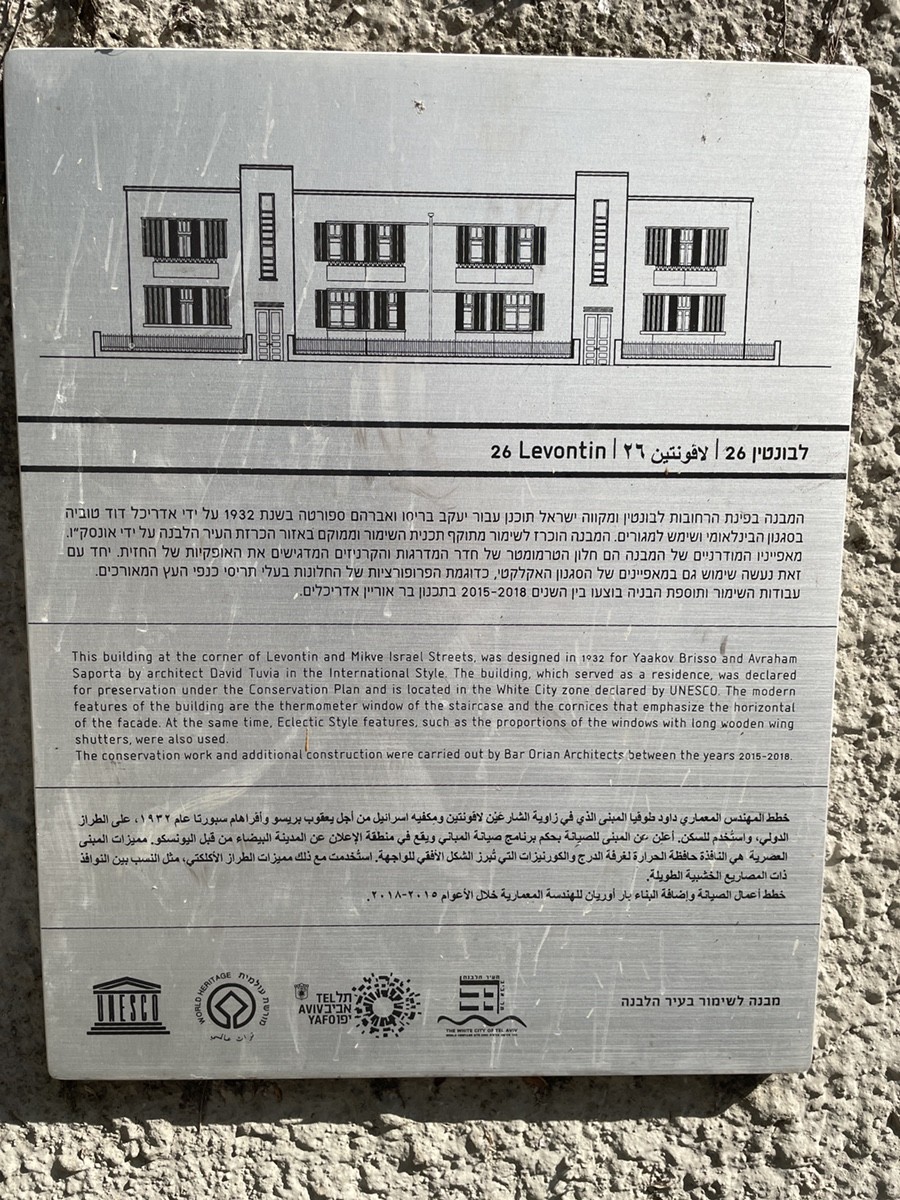

The house at the corner of Levontin and Mikveh Israel Streets was built in 1932, at a moment when young Tel Aviv, weary of suns and flimsy shacks, began to see itself as a true European city. The clients, **Yaakov Brisso** and **Avraham Saporta**, came from Levantine merchant families whose trade revolved around port shipments, coffee, textiles, and small real estate ventures. The building was more than an investment — it was a declaration of belonging: *we are no longer settlers; we are citizens.*
Architect **David Tuvia** chose the language of the new era — the **International Style**, where restraint itself became a form of elegance. He introduced a “thermometer window” — a vertical strip of light cutting through the staircase — and gave the house a sense of balance and airiness, like the sea breeze that carried with it faith in order and progress.
The **Saporta** family lived there until the early 1940s, after which the property passed to **Lea Wildenberg**, the widow of an engineer from the Electric Company, and later to **Eliezer Toktli**, a stationery merchant whose grandchildren still reside in the neighbourhood. After decades of neglect, the house was rescued by **Bar Orian Architects**, who restored its original proportions, discreetly added an upper floor, and preserved the façade — where the city’s story still breathes softly through the shade of its shutters.
You’ll walk through the very heart of old Tel Aviv — a neighbourhood where orange groves, missionary dreams, and the glow of early electricity all intertwined. The journey begins at the Model Farm and its iconic water tower, the birthplace of irrigation in Eretz Israel. From there, we’ll trace the footsteps of the Ishma’ilov family — Mashhadi *anusim* who built rental houses and inns for Persian merchants, yet lost much of their fortune under dramatic circumstances. We’ll pause in Gan HaHashmal, the city’s second public garden, which has witnessed the romance of the 1920s, decline, and the wave of 21st-century gentrification. The walk culminates at the grand Ohel Moed Synagogue — the “Tent of Meeting” — where eastern communities claimed their rightful place in the growing city. This is a journey through layers of time: from water to electricity, from merchant houses to gardens and synagogues — a story where every street guards a secret and every building speaks for its generation.