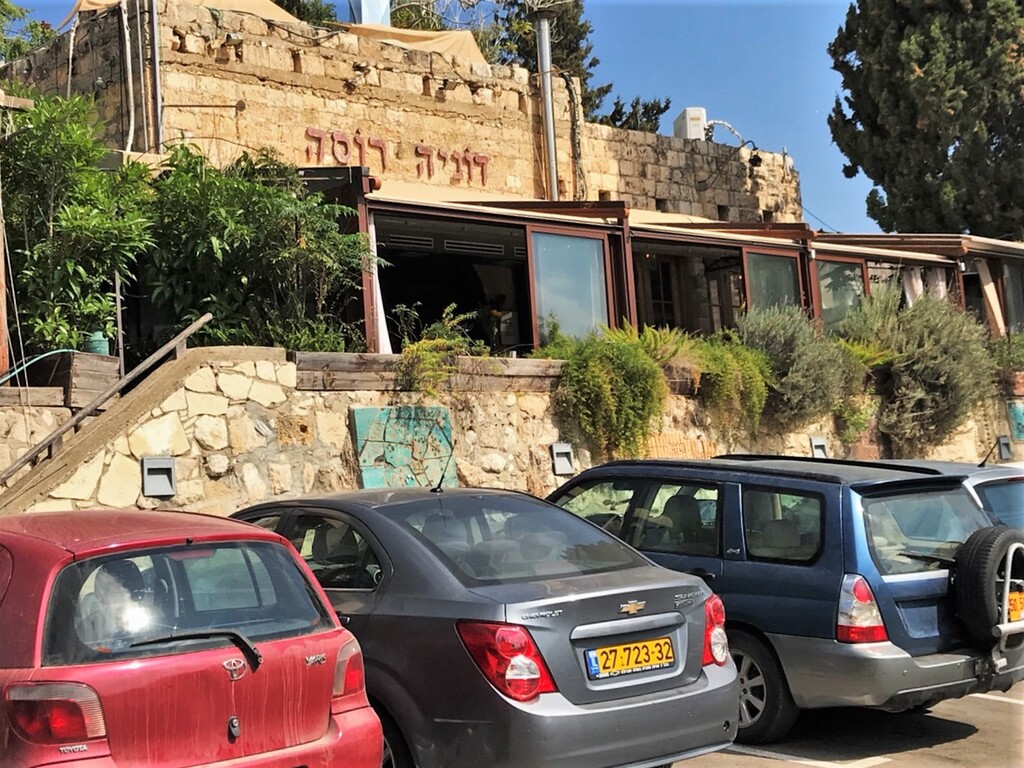

The square in Ein Hod is named in honor of Aba Hushi, the legendary mayor of Haifa, who played a pivotal role in the development of both the city and the artists' village of Ein Hod. Throughout his mayoralty, he was instrumental in establishing a university in Haifa, inaugurating theaters, and launching the Carmelit, Haifa's underground funicular railway.
His support extended beyond city infrastructure to the arts and cultural sphere. Aba Hushi was a staunch supporter of the artists in Ein Hod, nurturing close ties with eminent figures like Janko Dada and his contemporaries, including the up-and-coming Benjamin Levi. His deep involvement and contributions to the region's cultural and artistic scene are widely recognized and celebrated, marking his legacy in Ein Hod and beyond.
The streets of the artists' village of Ein Hod, strewn with autumn leaves, have a unique charm. Slightly worn by time, curvilinear and genuinely charming, they are shrouded in an atmosphere of kindness. Walking from the museum of Janko Dada, the founder of Dada, to the bronze sculptures of Benjamin Levi, you are greeted at every step by art in the most unexpected manifestations. This village has experienced a lot: from liveliness to decline, when houses stood empty, to its rebirth. The walls of its houses are mute witnesses of eras, cultures, the change of the Arab population by the descendants of Saladin's troops to Jewish Dada artists. The stones of these walls contain stories ranging from the times of the Crusaders, through the Arab heritage, to the Jewish restoration.
Today, sculptors, designers, musicians, architects, actors, singers, poets, jewelers, and potters live and work in Ein Hod. Many of them invite visitors to their workshops, organizing master classes and exhibitions. Ein Hod has no aspirations for high art or display of masterpieces, but there is a special atmosphere of simplicity, hospitality and pluralism, attractive in its ease and picturesqueness. Translated with Google Translate