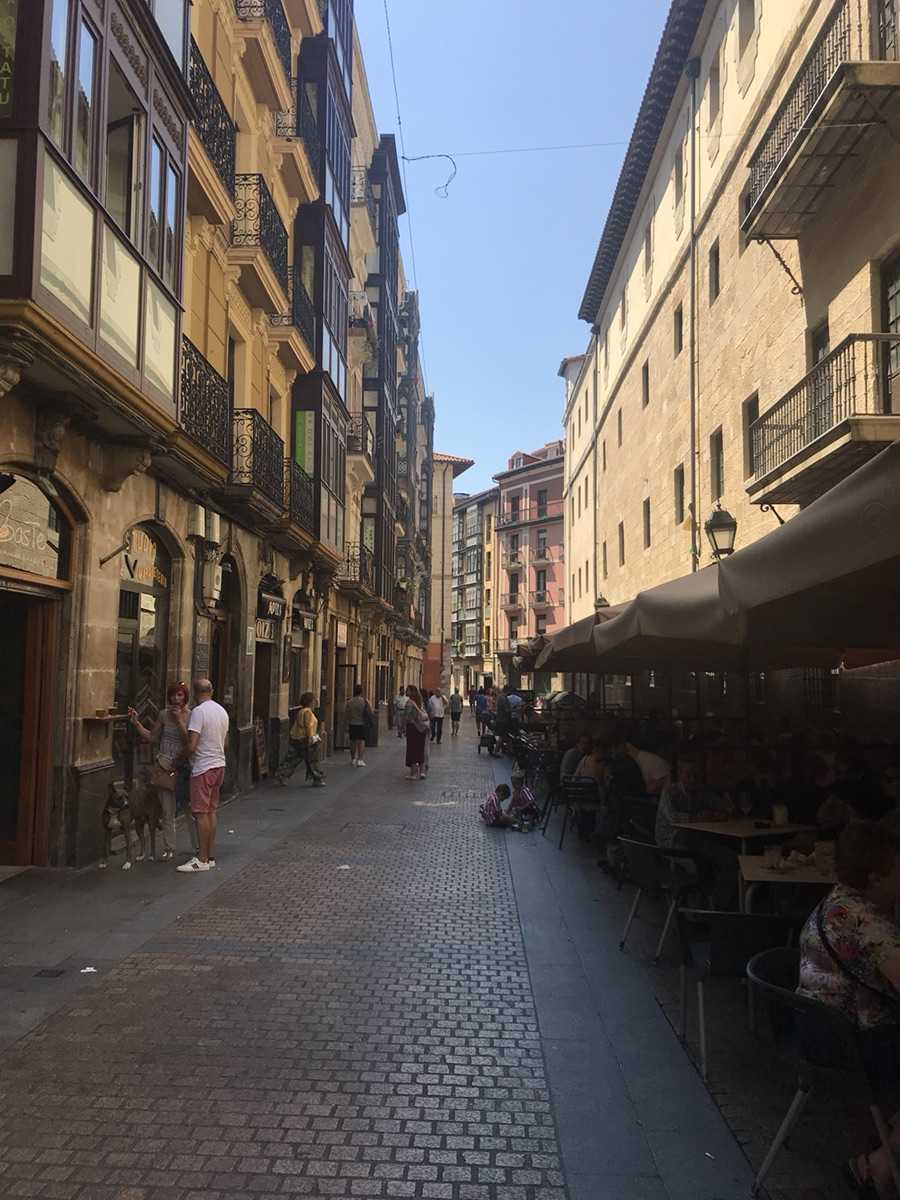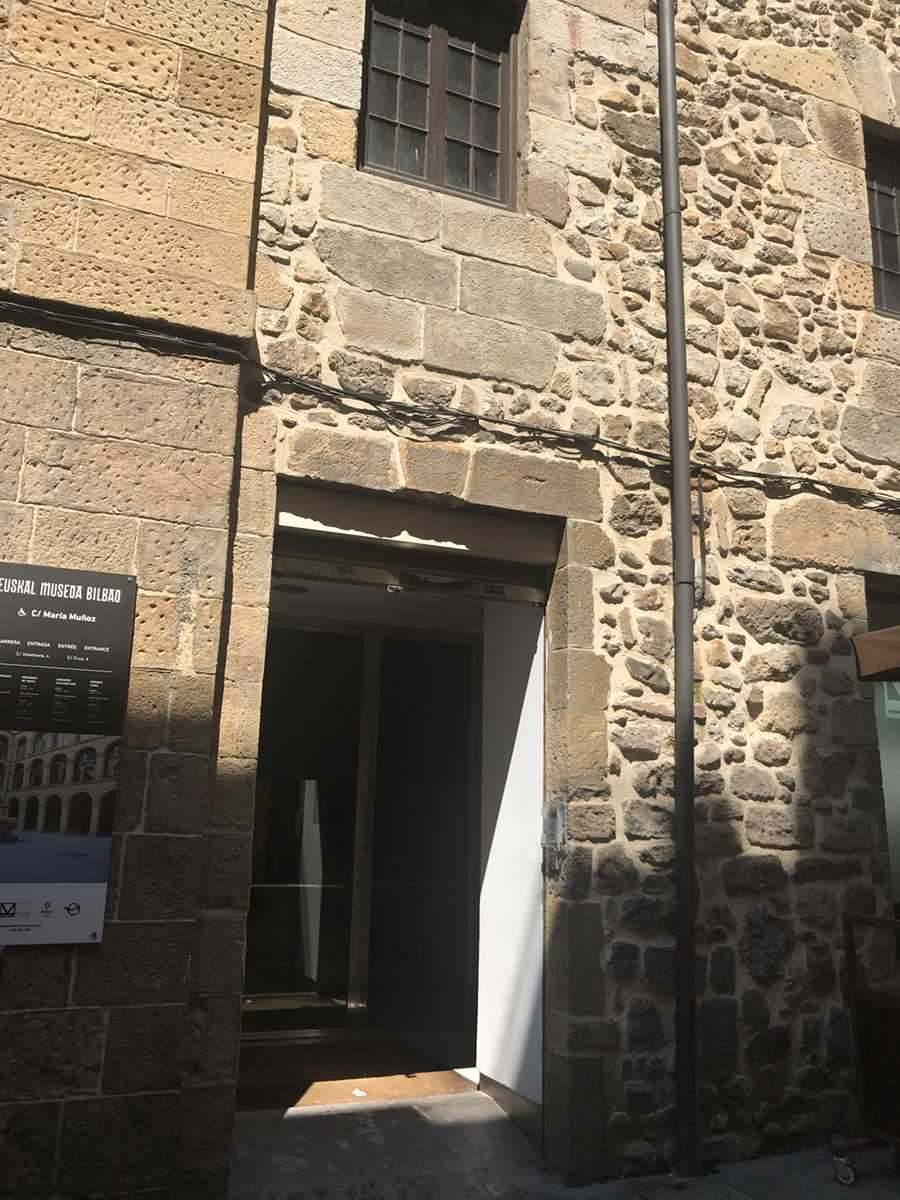

The Euskal Museoa — Bilbao’s Basque Museum — stands just off Miguel de Unamuno Square, inside a building that has lived many lives. Once a Jesuit college and monastery dedicated to Saint Andrew, it was built in the seventeenth century on the footprint of older homes, then expanded and altered over the centuries. Because of that, its façade reads like a timeline carved in stone.
At street level, around the portal, you see neat blocks of carved sandstone — the orderly square masonry typical of the seventeenth and eighteenth centuries, the era of monasteries and Baroque architecture. It gives the front of the building a sense of weight and quiet authority.
Higher up and along the sides, the stone changes completely: rough, uneven walls made of unshaped rocks and river boulders held together with lime mortar. These are the survival marks of earlier structures — pieces of medieval walls or old service buildings from the fifteenth and sixteenth centuries that were simply woven into the later monastery.
The museum sits inside all these layers at once, carrying the history of Bilbao’s most ancient quarter in its own walls long before you step through the door.
This walk is not just a stroll through the old streets of Bilbao — it’s a walk through the city’s memory. Everything here lies close together: the Gothic gates of Santiago Cathedral, the soft murmur of the “Dog Fountain,” the old plaques still marked by the great flood of 1983, and Bar Xukela, where the spirit of the city lives in a glass of wine and laughter at the counter.
We follow Calle del Perro and Calle de la Torre — streets whose names hold legends and the echoes of ancient family towers. At every turn, a story appears: about the Basques, whose defensive towers once stood like the stone houses of Svaneti; about Diego María Gardoki, the first Basque to serve as Spain’s ambassador to the United States; about Pedro Arrupe, the Basque priest who renewed the Jesuit order in the twentieth century.
Our path leads to the river where ships once lined the shore, and finally to El Arenal — the park where Bilbao learned to breathe, to love, and to listen to the quiet rhythm of its own heart.
This walk is like a simple, honest conversation with the city — no guide, no performance, just a friend who has a story waiting behind every corner.