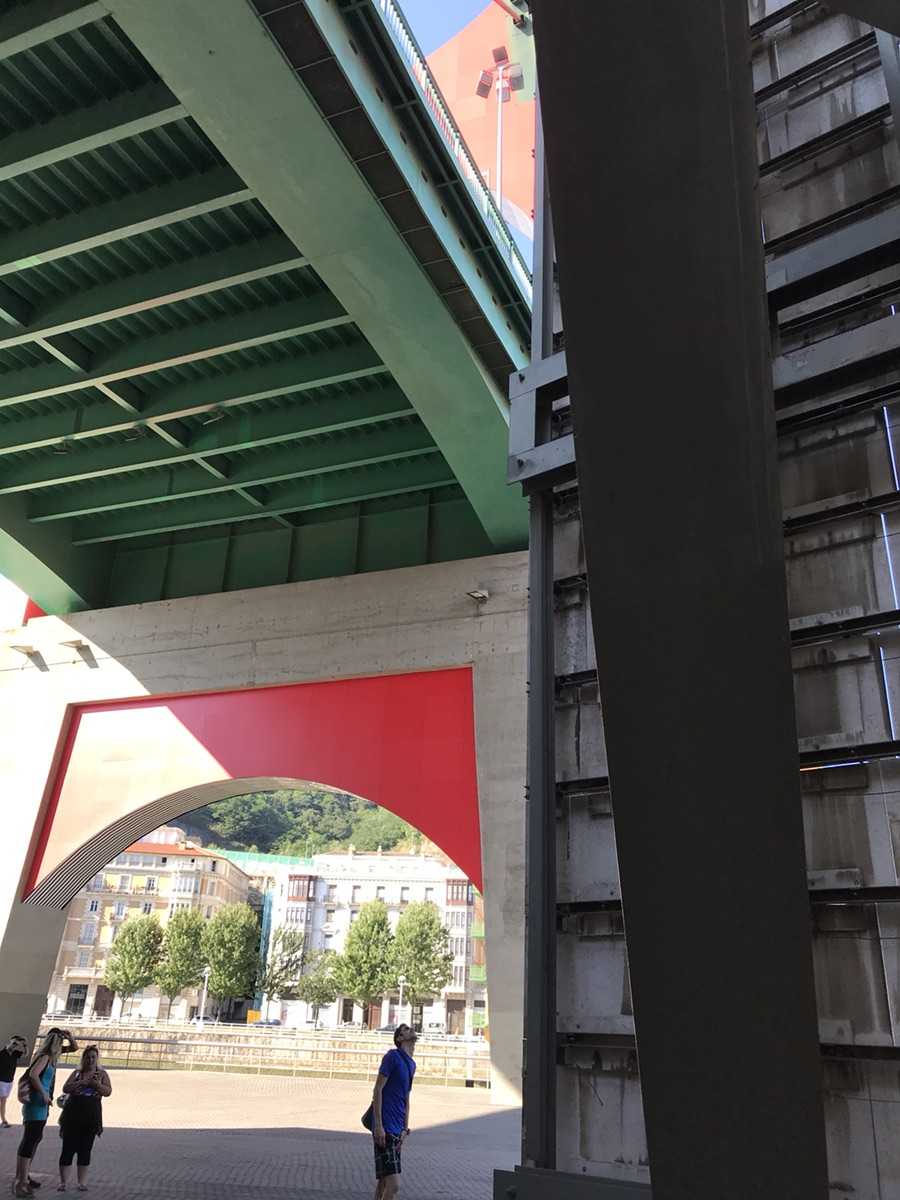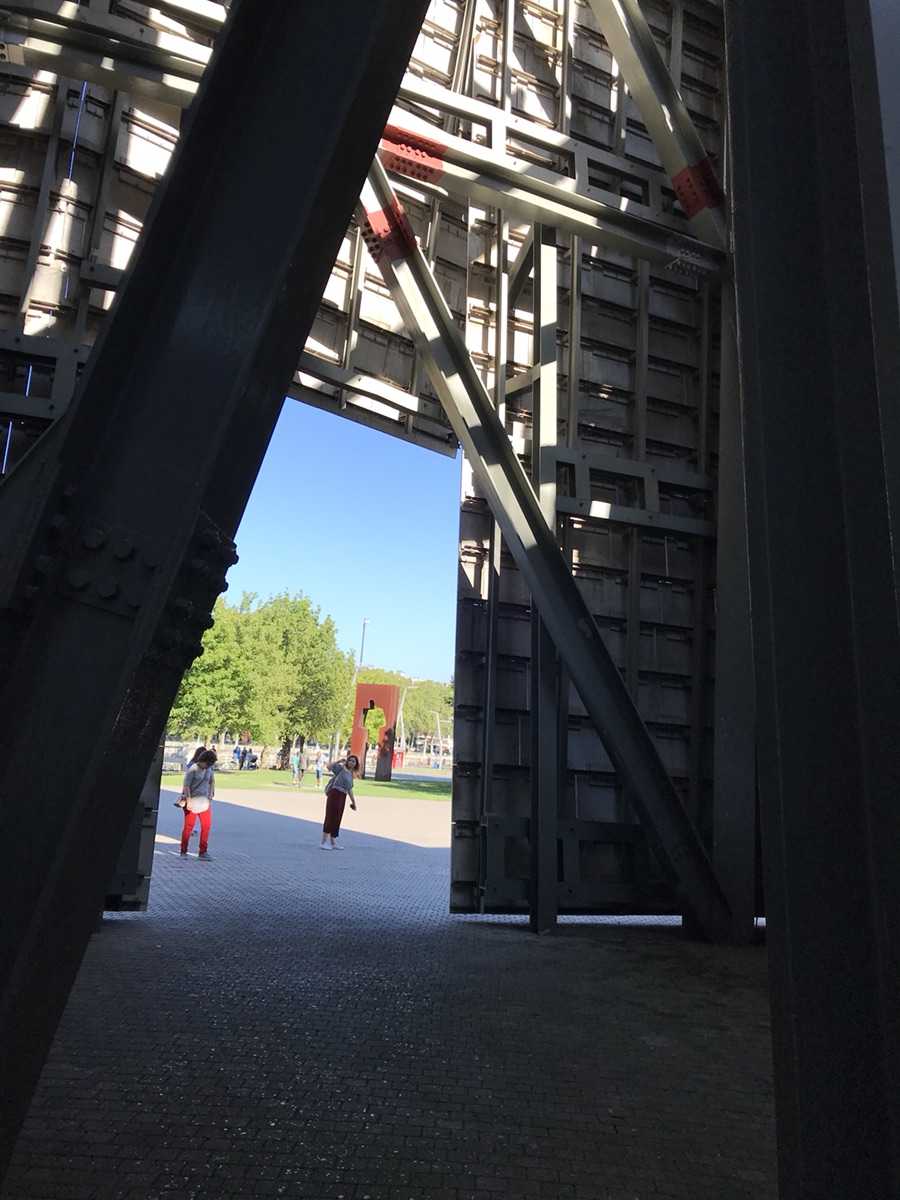

Under the green-and-red arches of the La Salve Bridge lies one of the most unexpected spaces in Bilbao. Once it was just an ordinary traffic junction; today it is part of the museum ensemble. Architect Frank Gehry chose not to hide the bridge but to turn it into an element of the artistic composition: the structure became a frame through which the city looks at itself.
In 2007, a giant arc by French artist Daniel Buren — Arcos Rojos — was added to the bridge’s massive supports. The bright red marks the boundary between industrial past and cultural present, between the city and the museum, between the road and the space of art.
The museum is named after Solomon Robert Guggenheim, an American collector and philanthropist born into a wealthy Swiss-Jewish family in Pennsylvania. In the 1930s he began collecting modern art — from Wassily Kandinsky to Paul Klee — and founded an institution in New York dedicated to “advancing new forms of artistic perception.” Later, his niece Peggy Guggenheim became one of the most influential figures in the art world, opening her own gallery in Venice.
Bilbao became the first European city entrusted by the Guggenheim Foundation with the family name for a new museum. In the 1990s, during a period of economic decline, the Basque government and the Guggenheim Foundation agreed to build a cultural anchor that could revive the entire region. And it worked. Today, the Guggenheim in Bilbao is not just a branch of an American institution but a symbol of how culture can transform a city.
Here beneath the bridge lies not a border but a point of connection — between eras, people, continents, and artistic forms.
The Guggenheim Museum in Bilbao is not just a building — it is a living space shaped by light, water, and metal. Its titanium curves echo the bends of the Nervión River and the forms of old ship hulls, as if the city remembered its past and turned it into art. Frank Gehry’s architecture does not follow symmetry; it moves, shifts, and seems to breathe with the wind and the reflections of the sky.
At the entrance stands “Maman” by Louise Bourgeois — a bronze spider where strength and care are woven together. The marble eggs beneath it symbolize life, vulnerability, and memory. Nearby, the red arch of the La Salve Bridge, redesigned by Daniel Buren, marks the transition between the city’s industrial past and its cultural renewal.
Inside, the museum becomes a temple of modernity. The central atrium — a cathedral of glass and light — connects three levels, each offering a new way to experience art. On the lower level, Richard Serra’s steel spirals The Matter of Time turn every step into sound. Higher up are rotating exhibitions, from Chagall to Vasconcelos, where art flows like a river. At the top level, the atmosphere becomes calm and deep: Rothko, Klein, Holzer, Bourgeois.
Everything here is connected: bridges, river, buildings, people. The city and the museum mirror each other. In this place, past, present, and future do not stand apart — they move and resonate together.