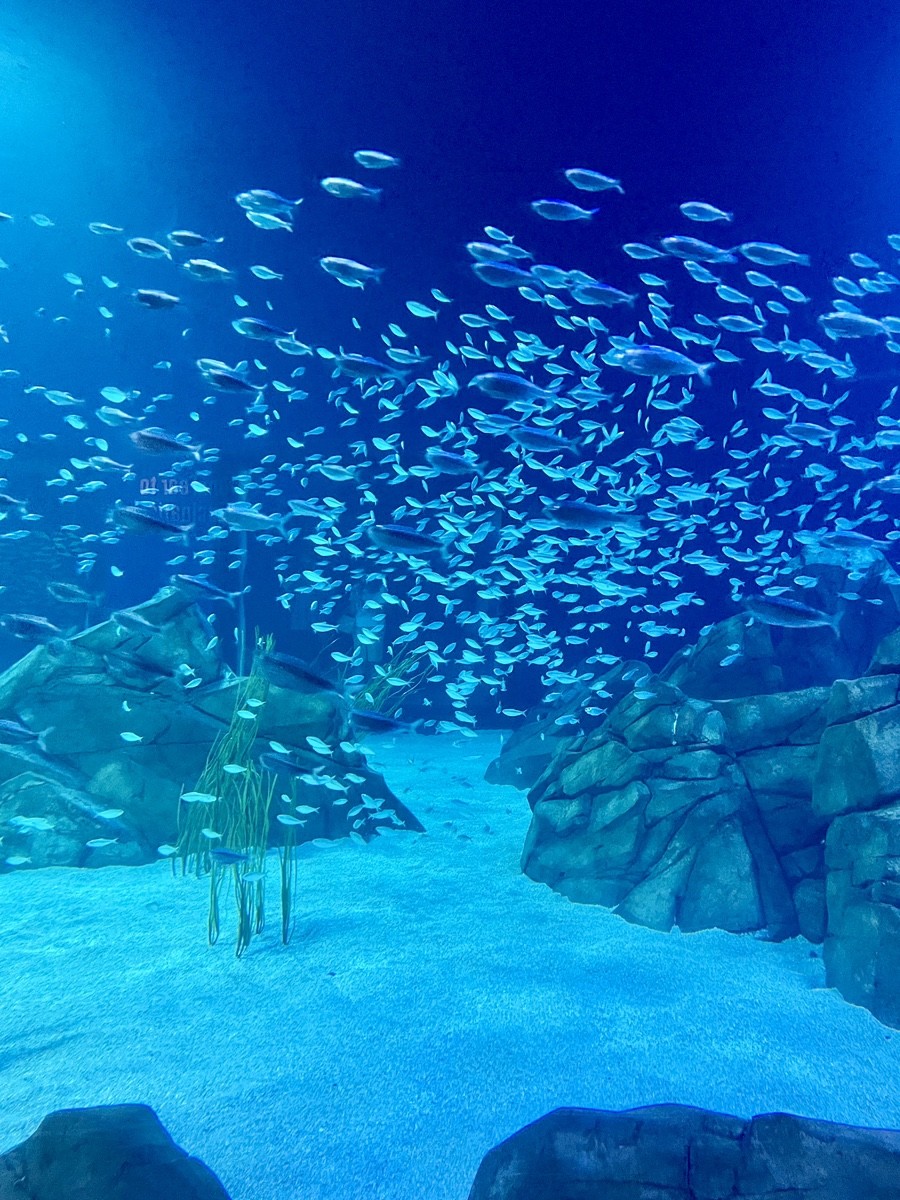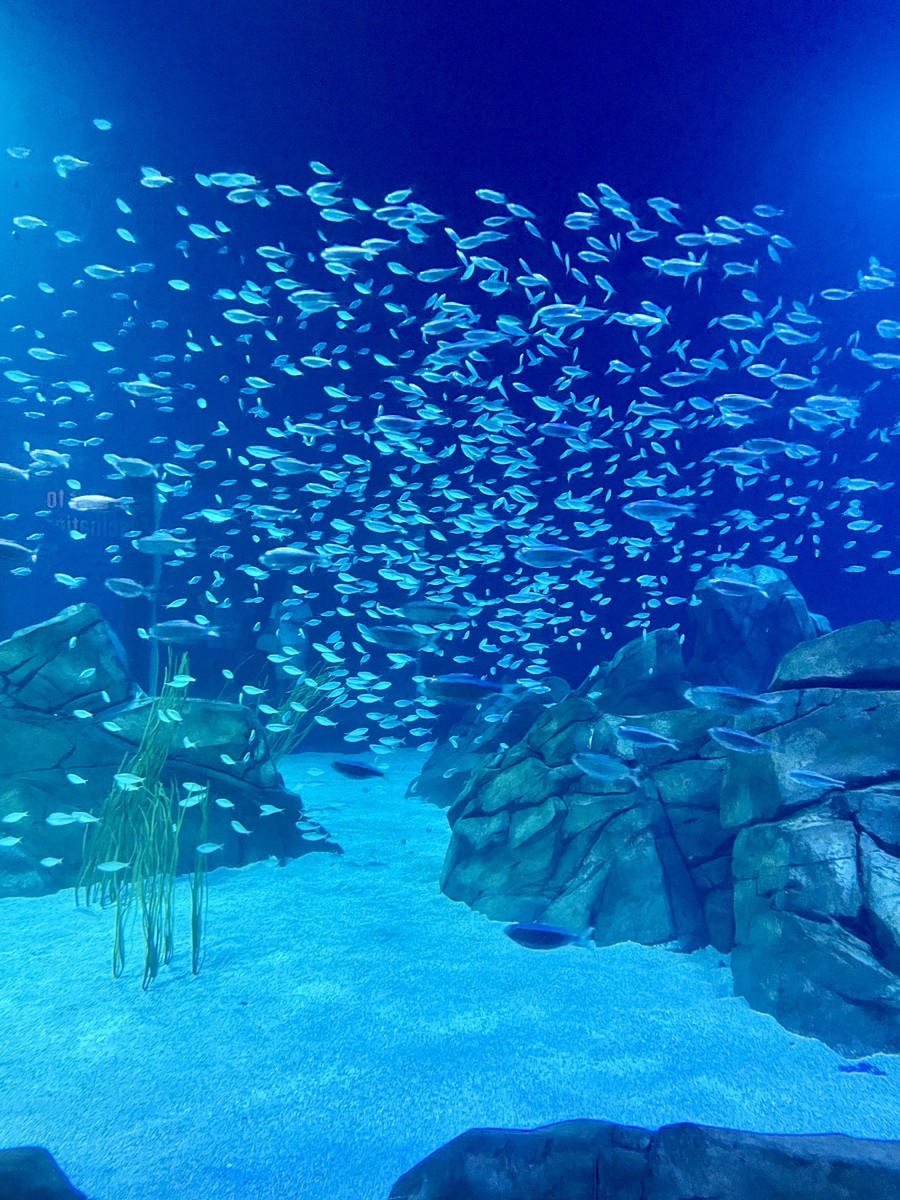

In front of the Georgia Aquarium’s massive viewing window, visitors witness a mesmerizing sight: a dense cloud of small silvery fish, the classic forage fish that form the base of the ocean’s food web. Moving as one, their synchronized turns create the illusion of a single living organism rather than thousands of individuals.
This survival strategy has been perfected over millions of years. By schooling tightly, each fish reduces its chance of being singled out. Predators are dazzled by flashes of silver, unable to focus on a target, and their attacks are scattered across the swarm. The response time is astonishing — within fractions of a second, the entire cloud shifts direction. The secret lies in the fishes’ lateral line, a sensory organ that detects tiny vibrations in the water, and in their wide-angle vision that keeps track of neighbors.
Normally, forage fish cruise at about 1–2 body lengths per second, but in a panic they can accelerate to 5–7 body lengths per second. To the human eye this looks like a sudden pulse through the school — a shockwave of motion that instantly reforms into a new shape.
In the wild, forage fish are the ocean’s most important resource, sustaining tunas racing at 70 km/h, powerful jacks and barracudas, diving seabirds, and entire pods of dolphins. Even in the aquarium, you occasionally see larger predators slice through the edges of the school, scattering the silver cloud before it fuses back together in seconds.
For humans, these fish are equally vital: commercial fleets harvest them with purse seines or lampara nets, often using lights at night to draw schools tighter before encircling them. In shallow waters, cast nets can capture them when the school brushes close to shore.
At the aquarium, biologists carefully manage the school with gentle currents and lighting, distributing food evenly to keep panic at bay. For visitors, it’s more than a dazzling display — it’s a lesson in ecology. These shimmering clouds of forage fish remind us that the ocean’s giants, from tuna to whales, ultimately depend on the smallest silver flashes in the sea.
Atlanta began as a modest railway stop — the end of the line that unexpectedly grew into the South’s busiest hub. The city was burned to the ground during the Civil War, yet out of the ashes rose a bold, industrious Atlanta. This is the birthplace of Coca-Cola, the cradle of the modern Civil Rights Movement, and home to the largest Black middle class in the United States. Few cities embody change and resilience the way Atlanta does.
At the heart of downtown lies Pemberton Place, a cultural crossroads where three icons stand side by side: the vast Georgia Aquarium, the playful World of Coca-Cola, and the moving Center for Civil and Human Rights. A short walk from the parking lot takes you past fountains and green lawns straight into this vibrant trio.
The Georgia Aquarium is breathtaking in scale — the largest in the Western Hemisphere. Its glass tunnel immerses you in the deep, as whale sharks and graceful manta rays glide overhead, surrounded by a dazzling cast of marine life. The highlight for many visitors is the dolphin presentation in the “Ocean Theater,” a show where science and spectacle merge to reveal the intelligence and energy of these remarkable animals.
The World of Coca-Cola tells another side of Atlanta’s story. From Dr. John Pemberton’s original pharmacy syrup to a brand recognized by billions, the museum traces the evolution of a cultural icon. Visitors marvel at the legendary vault said to guard the secret formula, and the experience ends in the famous tasting room — more than 100 flavors from 40 countries. From familiar Fanta and Sprite to exotic drinks that spark delight or surprise, every sip is part of a global journey that began right here in Atlanta.