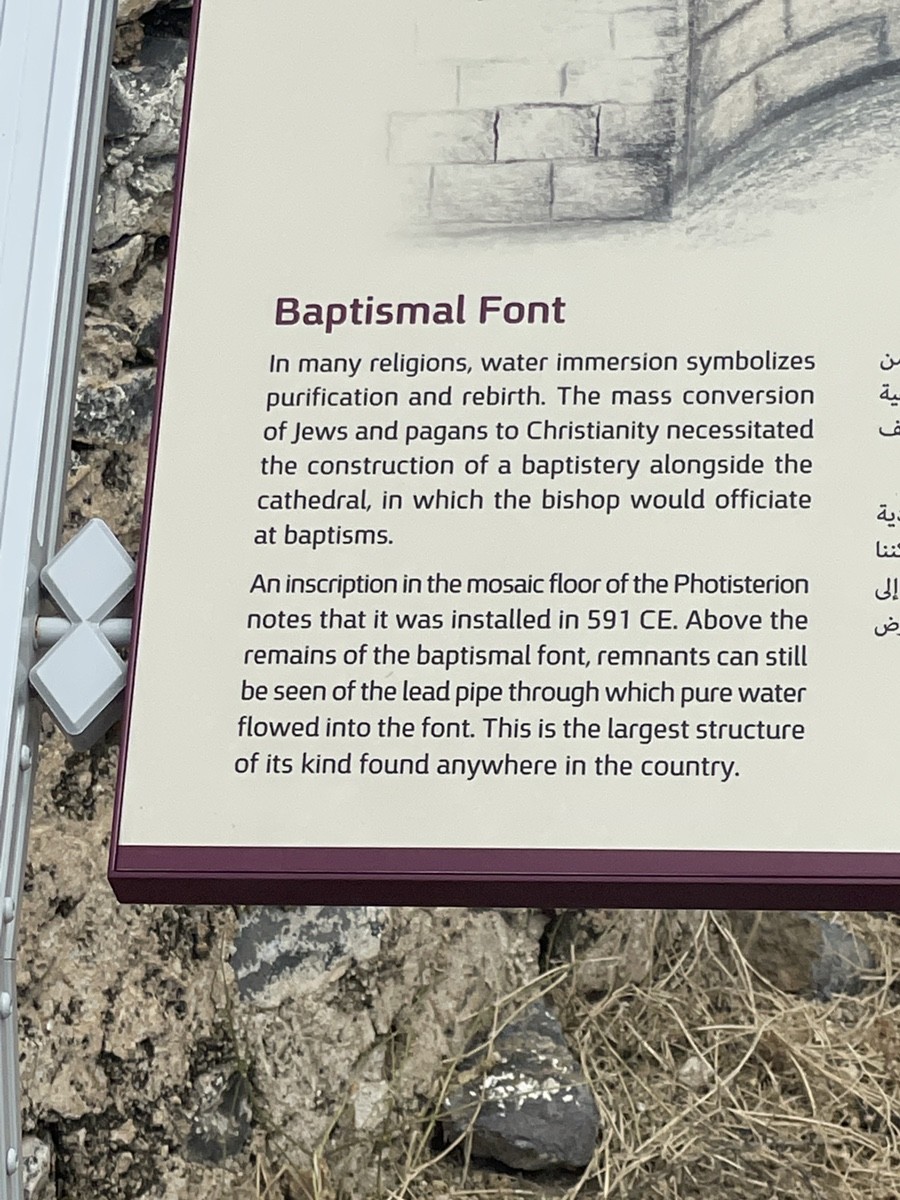

This place is the Photisterion (from the Greek for "Place of Enlightenment")—the baptistery adjacent to the Cathedral. It isn't just a simple room; it is the largest structure of its kind ever found in Israel.
The Photisterion: A Centre for Mass Enlightenment 1. The Engineering of the Rite In the centre of the room is the deep baptismal font. If you look closely at the edge, you can still see the remains of a lead pipe.
"Living Water": This pipe supplied "living" (running) fresh water to the font, which was a strict requirement for the baptismal ceremony.
The Architecture: The apse is built with a striking contrast—dark basalt at the base and lighter stone at the top, framed by the luxurious marble and mosaic floors we discussed earlier.
- A Concrete Date: 591 AD Archaeologists didn't have to guess when this was built. A Greek inscription woven directly into the mosaic floor explicitly states that the baptistery was installed in 591 AD.
Mass Conversions: This was a period of intense religious activity. Large numbers of locals—both Jews and pagans—were converting to Christianity under Byzantine rule.
The Bishop's Role: The sheer size of this separate building suggests that the Bishop of Sussita personally performed mass baptisms here for the growing community.
A Religious Superpower The fact that this is the largest baptistery in the country proves that in the late 6th century, Sussita was not a provincial backwater. It was a massive religious centre, rivalling Jerusalem in the quality and scale of its church architecture.
The Peak Before the Fall In the illustration, you can see the priest immersing a believer into the cross-shaped (or clover-shaped) font, symbolising rebirth and purification. It is poignant to realise that all this grandeur was created only about 150 years before the 749 AD earthquake "sealed" the city. We are looking at Sussita at the absolute height of its power.
Imagine the perfect spring morning in Israel—the sun is warm but not yet "blasting" you, and the air smells like fresh wildflowers. It's the absolute best time to grab the keys and head to the eastern side of the Kinneret (Sea of Galilee).
First Stop: Kursi & The Views Start your day at Kursi. It's this massive Byzantine monastery ruin where the vibe is just... super chill. You can walk across ancient mosaics and literally feel the history. But don't stay too long because the drive up the mountain is even better. Make sure to pull over at Mitzpe Nukieb. On a clear day, the view is insane—you see the whole blue "bowl" of the Kinneret stretched out from Tiberias to the Golan Heights. It's one of those "stop and just stare" moments.
The Main Event: Susita (Hippos) Then, you've got the crown jewel: Susita. It's like a ghost city sitting on a hill. They call it the "Pompeii above the lake." You'll walk through the old Roman forum and see giant columns that were knocked down by an earthquake 1,200 years ago and just... stayed there. It's got this wild mix of ancient Roman vibes and old Israeli military outposts.
Trains and Hummus When you head back down, swing by the old Tzemach train station. It's been restored and feels like a movie set from the early 1900s—back when trains ran all the way from Haifa to Damascus.
Finally, once you're officially "toured out," hit up Hummus Eliyahu at the Tzemach junction. Trust me, a warm bowl of creamy hummus with olive oil, fluffy pita, and a solid cup of coffee is the only way to end a trip like this.
Pro tip: Go right now while it's spring. The Golan is bright green, and everything looks like a masterpiece.