

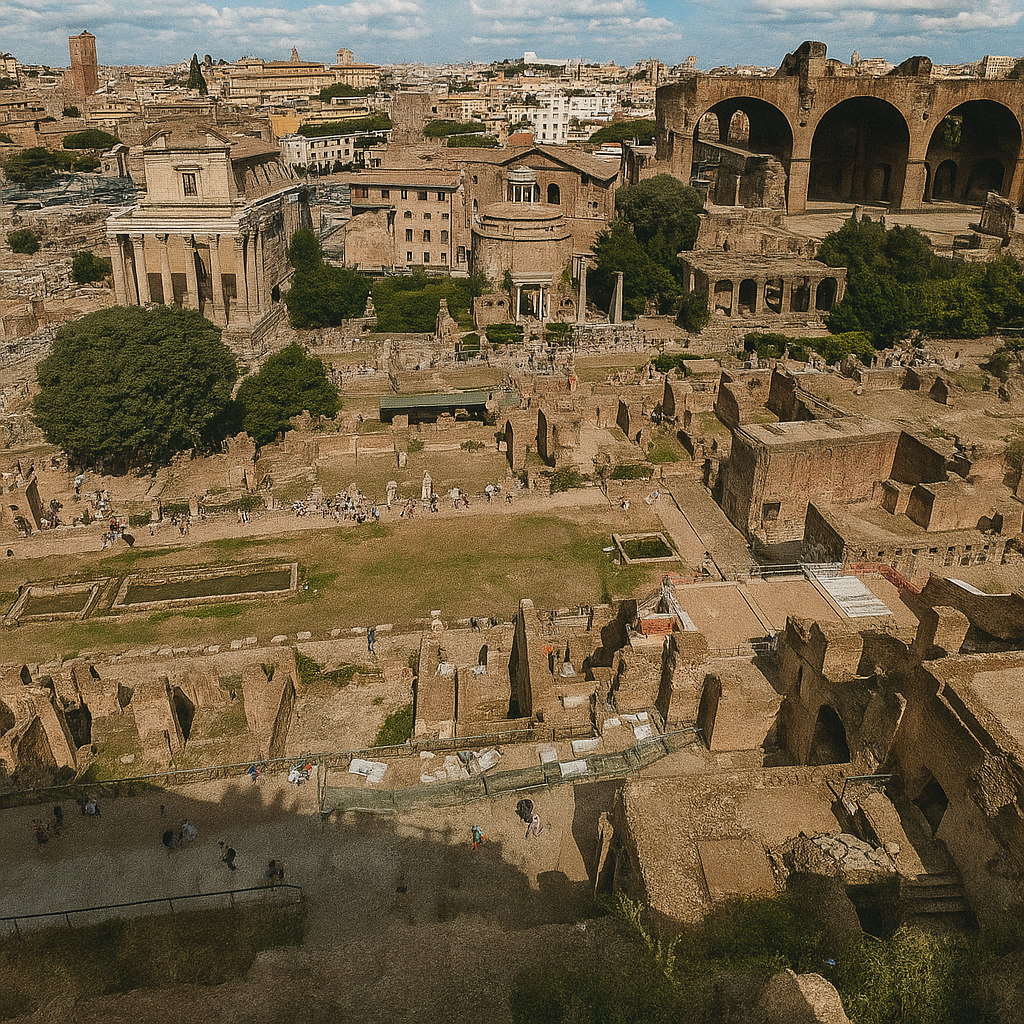
Palatine View – identifying each structure and its history in one narrative
Lower Palatine service and residential blocks Visible at the bottom of the photo are broken walls and corridors below the garden. Built under Domitian (81–96 CE) as the logistical base of the imperial palace: storerooms, staff quarters, supply corridors. After the empire collapsed, these rooms became stables and storage huts. Domitian died in a palace conspiracy, but his architectural framework defined the entire hill.
Peristyle courtyard with two long basins (Domus Flavia) Seen in the centre as a long rectangular garden with two shallow water channels. Created by architect Rabirius for imperial receptions. Delegations from the provinces were received here. The water cooled the courtyard and reflected incoming light. It functioned as a ceremonial stage for the Flavian dynasty.
Palatine terrace substructures Visible as massive brick arches on the lower right. These engineering platforms supported the palace's artificial terraces, built in the late 1st century CE. The design comes from the Flavian building program. In the Middle Ages, the same vaults served as foundations for fortified structures.
Church of San Lorenzo in Miranda (Temple of Antoninus and Faustina) Visible in the middle of the scene as a round, domed building. Beneath it stands the temple built in 141 CE by Antoninus Pius for his deified wife Faustina. Antoninus was one of Rome’s most stable rulers. In the Middle Ages, the temple became a church, which preserved the ancient walls and podium.
Temple of Saturn Seen as a group of columns left of the domed church. Originally from the 7th–6th c. BCE, rebuilt several times. It housed the state treasury (*aerarium*). The treasury was looted during the sack of Rome in 410 CE. Saturn symbolised Rome’s “golden age,” and the temple stood at the foot of the Capitoline.
Temple of Vespasian and Titus Visible as three isolated Corinthian columns to the right of the Temple of Saturn. Built by Domitian in the 80s–90s CE to honour his father Vespasian—restorer of order after 69 CE—and his brother Titus, conqueror of Jerusalem and inaugurator of the Colosseum. The temple was a dynastic memorial to the deified Flavians.
Basilica of Maxentius Seen on the right upper side are enormous surviving vaults. Begun by Maxentius (308–312 CE) and finished by Constantine after defeating him. Constantine replaced Maxentius’s colossal statue with his own. It was the largest roofed hall in the Forum, with arches rising over 35 meters.
Slopes of the Via Sacra Visible as green strips between the temples and the basilica. This was Rome’s main ceremonial route. Triumphs of Caesar, Augustus, Trajan and Titus passed here. In the Middle Ages, it became a simple path through pastureland but retained its ancient line.
Ruins of tabernae, shrines and workshops Seen in the centre are tightly packed low brick walls. These were shops, small sanctuaries, administrative rooms and artisan spaces. Financial transactions, lending and everyday commerce took place here. Archaeologists have found graffiti with political jokes from the late Republic.
Background districts of Monti and Centro Storico Visible on the horizon is the modern city behind the Forum. These quarters evolved from the medieval and Renaissance neighbourhoods built atop ancient Subura. In the 20th century, Monti became associated with artisans, small theatres and early film actors from Cinecittà.
Path descending from the Palatine Seen at the very bottom edge as the walkway running across the frame. This modern visitor route follows the line of an ancient service road that brought water, food, and fuel into the imperial palace. It remained in use through late antiquity, the Middle Ages, and into the 19th century.
Rome rises on seven hills, and this walk takes us across two of its most revealing ones — Esquiline and Palatine. The Esquiline, once the city’s eastern edge, still carries traces of imperial gardens, hidden nymphaea, magical gates, and traditions that survived the fall of the empire. The Palatine, the hill of the emperors, preserves stadiums, palaces, terraces and views where the entire history of Rome — Republic, Empire, Middle Ages, Baroque and modern Italy — lies in a single panorama. Along the way, we meet the monuments, streets and layers we uncovered in this journey: the baths of Trajan, the Domus Aurea beneath the grass, the Palatine stadium, the Forum’s arches and temples, and the buildings that reshaped Rome across two millennia. And we pause for something timeless: a pastry shop on the Esquiline that has kept its flavours unchanged for more than a century — a taste of Rome as constant as its stones.
