

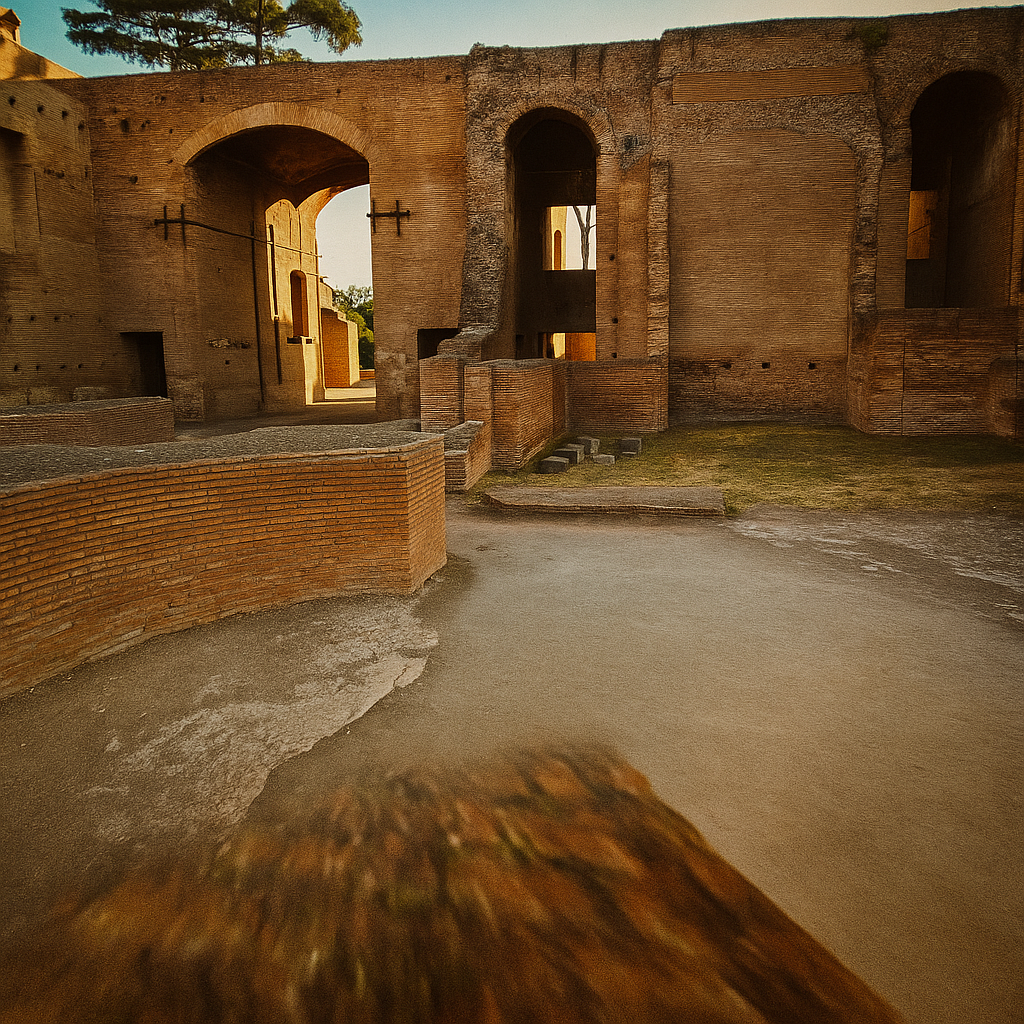
The Fountain of the Pelte on the Palatine is the modern name for a fragmentary nymphaeum decorated with shield-shaped reliefs (*peltae*), a motif associated with Dionysian imagery and palace garden décor of the Julio-Claudian and Flavian eras. It belonged to the water-display system of the imperial residences and likely dates to the 1st century CE, functioning both as a cooling element and as part of the ornamental program of the palace terraces.
The **Aula Isiaca** is an underground hall with Egyptianizing decoration from the late Republican or early Augustan period. Its name comes from the wall paintings inspired by the cult of Isis — a fashion among elite Romans who associated Egyptian imagery with luxury and esoteric prestige. It was later incorporated into the Renaissance *Loggia Mattei*, when the Mattei family reused the surviving ancient structure and added an open loggia above it.
The **Domus Augustana**, built under Emperor Domitian in the late 1st century CE and designed by his architect Rabirius, formed the private wing of the vast Palatine palace complex. Its courtyards, audience halls and private apartments formed the administrative and residential core of imperial power for centuries. After the 3rd century, the complex was modified by the Severan emperors; by late antiquity, parts were repurposed as service quarters and administrative offices. In the Middle Ages, the ruins became part of fortified enclosures controlled by Roman noble families; in the Renaissance, many areas were absorbed into the Horti Farnesiani. These spaces appear in archaeological literature and modern documentaries but have no major film depictions; surviving legends relate mainly to the Isis hall, which early antiquarians misinterpreted as a sanctuary rather than a decorative room. Together, these structures reflect the evolution of Palatine architecture from Republican elite houses to the formalised palace of the emperors and its later transformations.
Rome rises on seven hills, and this walk takes us across two of its most revealing ones — Esquiline and Palatine. The Esquiline, once the city’s eastern edge, still carries traces of imperial gardens, hidden nymphaea, magical gates, and traditions that survived the fall of the empire. The Palatine, the hill of the emperors, preserves stadiums, palaces, terraces and views where the entire history of Rome — Republic, Empire, Middle Ages, Baroque and modern Italy — lies in a single panorama. Along the way, we meet the monuments, streets and layers we uncovered in this journey: the baths of Trajan, the Domus Aurea beneath the grass, the Palatine stadium, the Forum’s arches and temples, and the buildings that reshaped Rome across two millennia. And we pause for something timeless: a pastry shop on the Esquiline that has kept its flavours unchanged for more than a century — a taste of Rome as constant as its stones.
