

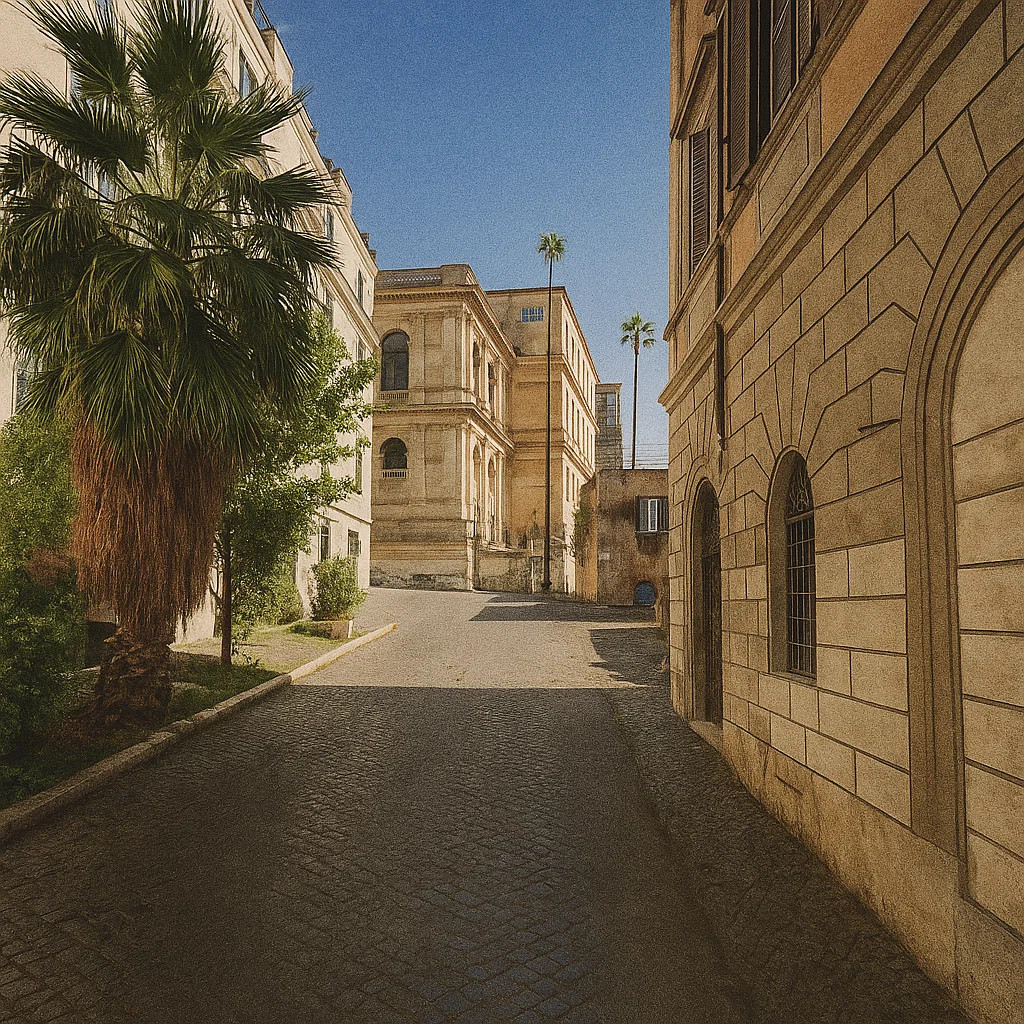
What makes Via della Polveriera interesting is not the building itself, but the history that runs beneath and around it. The street descends along the slope of Colle Oppio between Largo della Polveriera and Via del Fagutale, right in the Monti district. Its name comes from the gunpowder depots that stood here from the 17th century onward — storage sites serving the Roman garrison and later the Napoleonic troops. In 1694, one of these depots exploded, a blast strong enough to be remembered for generations as a reminder of how dangerous such warehouses were inside the city’s core. A quieter but equally fascinating layer lies beneath the pavement. In the late 19th century, archaeologists uncovered a fragment of the Forma Urbis, the massive marble map of ancient Rome, right near the modern stretch of Via della Polveriera. Excavations along the Colle Oppio slope continue to reveal details of the ancient landscape between Trajan’s Baths and the old Fagutal quarter — a reminder that even ordinary streets in Rome sit on centuries of hidden topography.
Rome rises on seven hills, and this walk takes us across two of its most revealing ones — Esquiline and Palatine. The Esquiline, once the city’s eastern edge, still carries traces of imperial gardens, hidden nymphaea, magical gates, and traditions that survived the fall of the empire. The Palatine, the hill of the emperors, preserves stadiums, palaces, terraces and views where the entire history of Rome — Republic, Empire, Middle Ages, Baroque and modern Italy — lies in a single panorama. Along the way, we meet the monuments, streets and layers we uncovered in this journey: the baths of Trajan, the Domus Aurea beneath the grass, the Palatine stadium, the Forum’s arches and temples, and the buildings that reshaped Rome across two millennia. And we pause for something timeless: a pastry shop on the Esquiline that has kept its flavours unchanged for more than a century — a taste of Rome as constant as its stones.
