

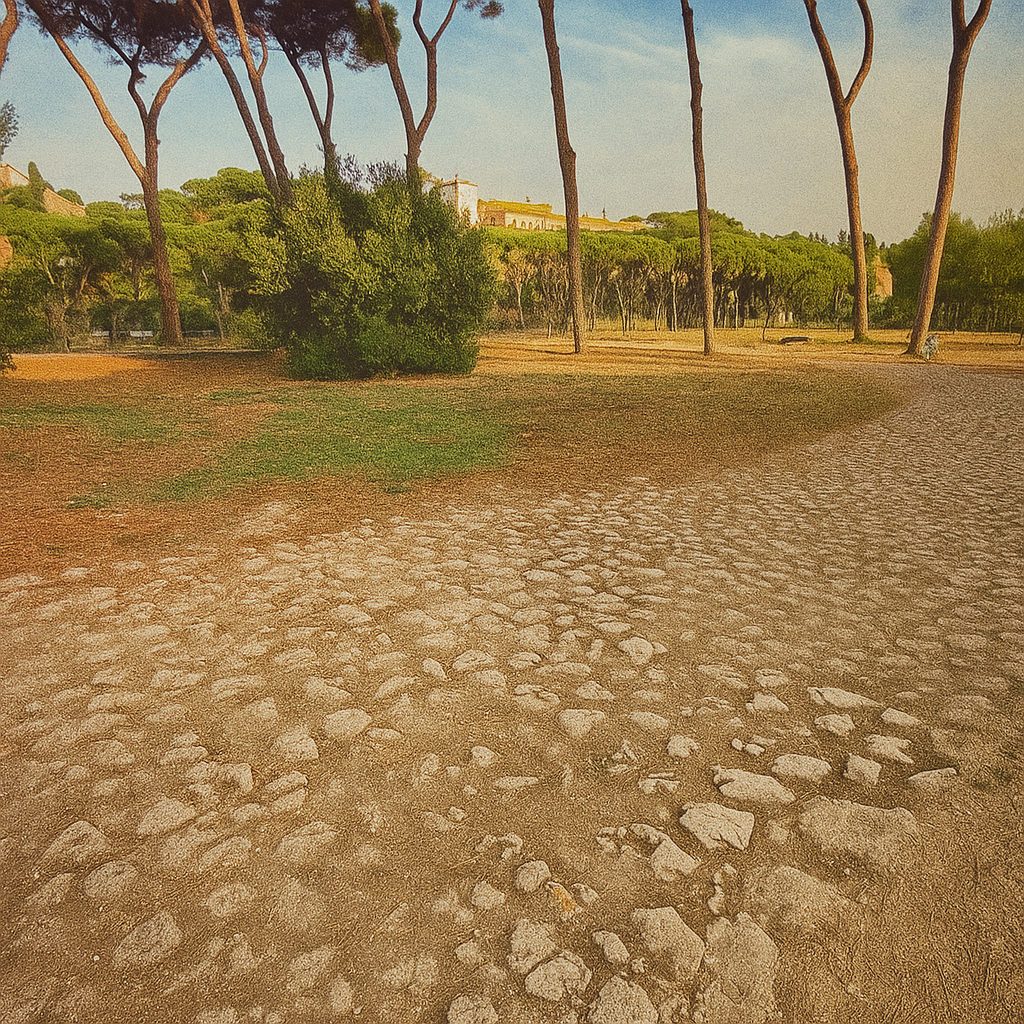
What you’re looking at is one of those Roman details that almost disappears under your feet: an old stone path climbing the Palatine slope, a fragment of the circulation system that once stitched together the palaces, gardens, and service areas of the imperial hill. It rises from the area of the Palatine Nymphaeum. It moves upward toward the Nymphaeum of the Cistern and eventually to the Stadium of Domitian, which sits like a private racetrack on the hilltop. This path wasn’t a grand ceremonial road — it was part of the practical, everyday infrastructure of the Palatine. Enslaved people, gardeners, attendants, and officials used routes like this to move between terraces, water installations, and the secluded spaces of the imperial residences. And this is where the Palatine shows its true nature. Each emperor might have added new wings, new fountains, new halls, but the hill itself held everything together. The Palatine wasn’t one palace — it was an entire landscape engineered into levels: nymphaea for display, cisterns for water storage, ramps and paths for circulation. This rough stone pavement is a surviving trace of that system. It’s the “backstage corridor” of imperial Rome. The slope you’re walking up links three essential elements: • the lower pleasure gardens, fed by aqueduct water and cooled by fountains; • the service heart of the hill, where cisterns and channels controlled the water supply; • the emperor’s private stadium, a long garden space used for walks, exercises, and formal receptions. What makes this little path special is how quietly it bridges those layers. You’re literally walking the same gradient that palace workers used when the Palatine was the centre of the empire. The seven hills of Rome were never isolated humps of land — they were connected by movement, by water, by sightlines. And here, on this weathered stone road, that interconnected landscape is still visible. From the nymphaeum at the base to the stadium at the summit, this path is a reminder that Rome’s power was not only in its monuments but in the way its hills were shaped, linked, and made to work together.
Rome rises on seven hills, and this walk takes us across two of its most revealing ones — Esquiline and Palatine. The Esquiline, once the city’s eastern edge, still carries traces of imperial gardens, hidden nymphaea, magical gates, and traditions that survived the fall of the empire. The Palatine, the hill of the emperors, preserves stadiums, palaces, terraces and views where the entire history of Rome — Republic, Empire, Middle Ages, Baroque and modern Italy — lies in a single panorama. Along the way, we meet the monuments, streets and layers we uncovered in this journey: the baths of Trajan, the Domus Aurea beneath the grass, the Palatine stadium, the Forum’s arches and temples, and the buildings that reshaped Rome across two millennia. And we pause for something timeless: a pastry shop on the Esquiline that has kept its flavours unchanged for more than a century — a taste of Rome as constant as its stones.
