

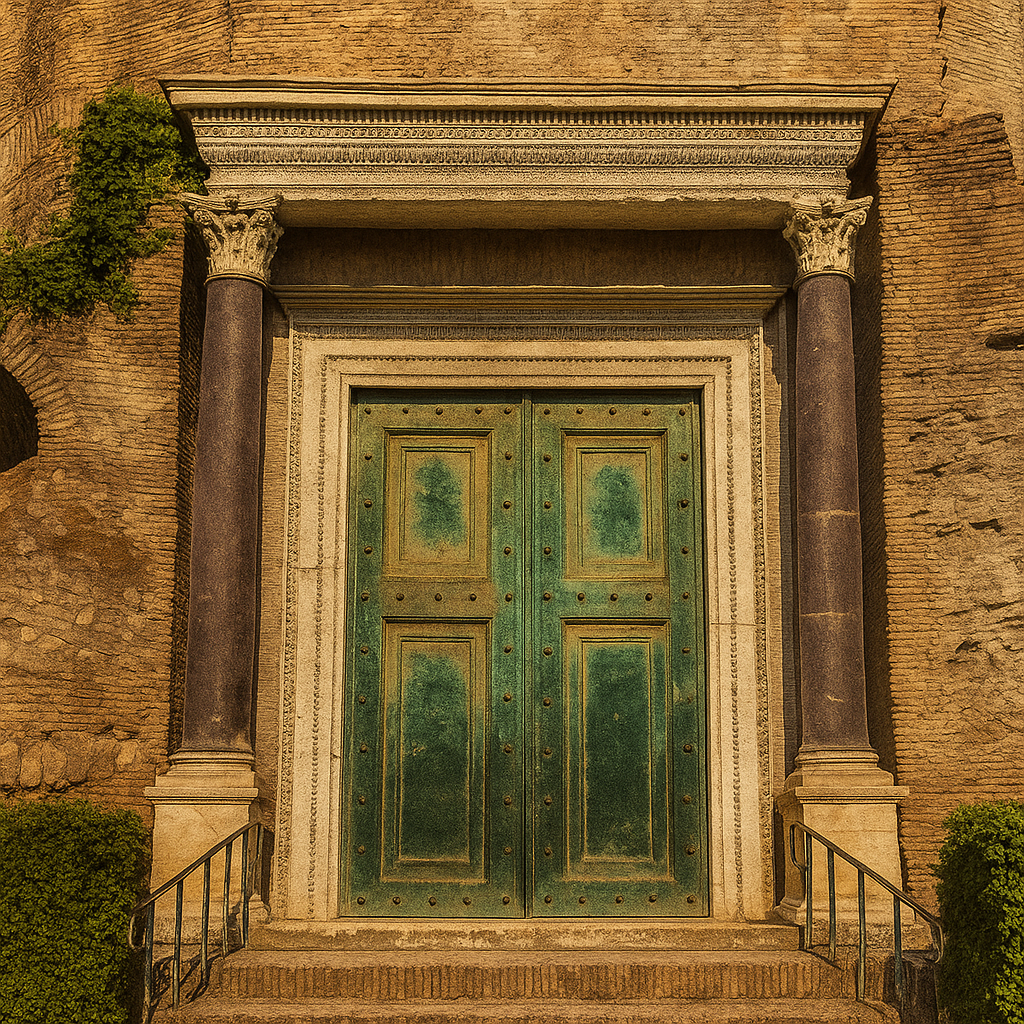
The building in the photo is commonly mistaken for a shrine to Rome's legendary founder, but it has nothing to do with that Romulus. It is the Temple of Romulus, the son of Emperor Maxentius, built around 307–309 CE during one of the most chaotic moments of the late Roman Empire. At that time, five men simultaneously claimed the title of emperor and fought for control. Maxentius, who ruled from Rome, used the temple as a political statement. By dedicating a monument to his young son, he tried to project an image of dynastic legitimacy that he never truly possessed. The entrance you see — framed by deep-purple porphyry columns — preserves one of the rarest survivals in the Forum: its original bronze doors, almost intact after seventeen centuries. The round hall behind them reflects the typical brickwork and proportions of late-imperial architecture. After Constantine defeated Maxentius at the Battle of the Milvian Bridge in 312 CE, the temple quickly lost its purpose. But the structure was so solid and conveniently positioned that it was incorporated into the vestibule of the Christian basilica of Saints Cosmas and Damian, the first major church to be established directly inside the Roman Forum. A pagan shrine built by a doomed ruler for an undistinguished child became the entrance to a Christian sanctuary — one of the striking ironies of late Roman history. The adjacent structure — the so-called "Carcer" Next to the temple stands a small block long known as the Carcer ("the prison"). The name is misleading. It appeared in the 18th–19th centuries, when the area was poorly understood and archaeologists often assigned functions based on guesswork. Modern research shows that the building contained service rooms — storerooms or administrative spaces from the late imperial period, likely also dating to Maxentius's building program. In the Middle Ages, the structure was incorporated into the basilica's monastic complex and later used as part of its functional spaces. No prisoners were held here, no executions took place, and no ancient sources connect it with judicial activity. Its history is a reminder that names in the Forum often outlive the facts and must be corrected as archaeology advances.
Rome rises on seven hills, and this walk takes us across two of its most revealing ones — Esquiline and Palatine. The Esquiline, once the city’s eastern edge, still carries traces of imperial gardens, hidden nymphaea, magical gates, and traditions that survived the fall of the empire. The Palatine, the hill of the emperors, preserves stadiums, palaces, terraces and views where the entire history of Rome — Republic, Empire, Middle Ages, Baroque and modern Italy — lies in a single panorama. Along the way, we meet the monuments, streets and layers we uncovered in this journey: the baths of Trajan, the Domus Aurea beneath the grass, the Palatine stadium, the Forum’s arches and temples, and the buildings that reshaped Rome across two millennia. And we pause for something timeless: a pastry shop on the Esquiline that has kept its flavours unchanged for more than a century — a taste of Rome as constant as its stones.
